
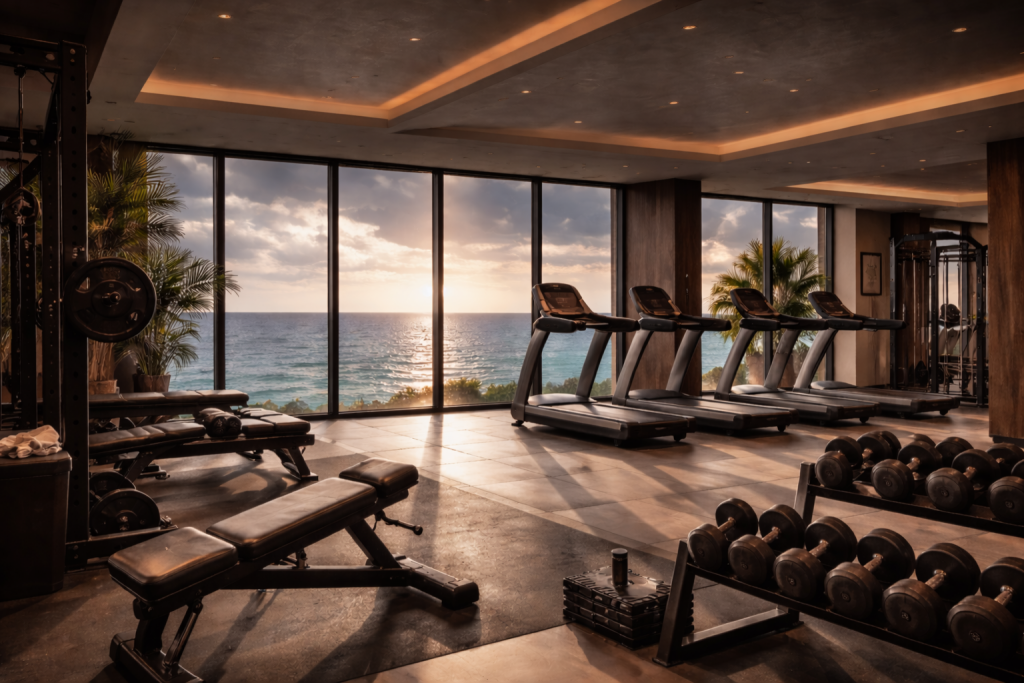
Digital illustration of the intended design and atmosphere. Final layouts and finishes may vary.
What Most Gyms in Barbados Get Wrong
Many gyms in Barbados are designed around one objective: accommodating as many members as possible. Success is often measured by the number of machines on the gym floor, the variety of group classes, or the size of the membership base. While this model works for the general market, it rarely serves professionals who depend on consistency to perform at a high level. They do not simply need somewhere to exercise. They need an environment that fits naturally into an already structured day. Too often, they arrive only to wait for equipment, adjust their programme because a machine is occupied, or shorten their session because time has slipped away. Even many premium facilities continue to operate this way. Training happens in one location, recovery somewhere else, and productive work in another place entirely. Every transition introduces friction. Every interruption weakens momentum. Over time, those seemingly minor inconveniences become the reason healthy routines begin to break down. The problem is not a lack of commitment. It is the absence of an environment designed to support consistent performance.
Why Rhythm Matters More Than Intensity
Many people believe exceptional results come from working harder, training longer, or constantly increasing intensity. While effort certainly matters, long-term performance is built on rhythm rather than extremes. Rhythm creates predictability. It removes unnecessary decisions and allows the body and mind to settle into routines that become almost automatic. When professionals know where they will train, when recovery will happen, and how the rest of the day will unfold, physical and mental energy are preserved for work that truly matters. Recovery improves because it is no longer postponed. Nutrition becomes more consistent because meals are planned into the routine rather than squeezed between meetings. Training becomes sustainable because it fits naturally into the day instead of competing against it. High performers understand that consistent effort repeated over months and years produces greater results than occasional periods of extraordinary intensity followed by exhaustion.
Why Barbados Requires a Different Approach
Barbados has evolved far beyond its traditional image as a holiday destination. Today, the island attracts entrepreneurs, executives, business owners, and remote professionals who manage companies and teams across multiple countries and time zones. These individuals are not searching for another busy commercial gym. They are looking for environments that simplify life rather than adding more decisions to an already demanding schedule. Every unnecessary choice consumes attention. Deciding where to train, where to recover, where to work, and where to eat may seem insignificant individually, but together these decisions create mental fatigue long before the working day has ended. Professionals operating at a high level increasingly value environments where these functions exist together. They understand that reducing cognitive load often improves performance more effectively than working harder.
Why Intensity Alone Eventually Stops Working
Periods of intense effort often produce impressive short-term results. Hard training sessions, demanding work schedules, and relentless ambition can certainly move someone forward for a while. Eventually, however, every system reaches its limit. Sleep becomes inconsistent. Recovery is delayed. Small injuries take longer to heal. Concentration declines during important meetings. Productivity begins to fluctuate despite increasing effort.
The solution is rarely to push even harder.
Instead, sustainable performance comes from balancing effort with structure. High performers seek steady progress rather than dramatic peaks followed by inevitable crashes. They understand that protecting energy allows them to continue performing week after week without constantly rebuilding lost momentum. Rhythm creates stability. Stability supports consistency. Consistency ultimately produces the results that intensity alone cannot maintain.
The Hidden Cost of Fragmented Routines
Many professionals underestimate how much energy is consumed simply moving between different parts of the day. Every journey across town, every change of environment, every delayed meal, and every postponed recovery session requires another mental adjustment. Individually these interruptions appear minor. Collectively they create a fragmented routine that slowly becomes more difficult to sustain.
This often appears in subtle ways. Workouts become shorter because meetings overrun. Recovery is skipped because another appointment follows immediately afterwards. Healthy meals are replaced with convenient alternatives because there is no time to stop. By evening, the body feels physically tired while the mind feels mentally overloaded.
The issue is rarely laziness or poor discipline.
The issue is that the environment constantly forces professionals to adapt instead of allowing them to follow a predictable routine.
Why Integrated Environments Produce Better Results
An integrated environment changes the experience completely because it removes unnecessary transitions from the day. Instead of travelling between multiple facilities, members arrive once and move naturally through each stage of their routine. Training begins without delay. Recovery follows immediately afterwards. Productive work continues in a calm environment. Nutritious meals are available without requiring another journey across the island.
This continuity protects both physical and mental performance. There are fewer interruptions, fewer opportunities for routines to break down, and fewer decisions competing for attention. Rather than constantly restarting throughout the day, professionals remain within one structured rhythm that supports consistent output from morning until evening.
The objective is not simply convenience.
It is preserving energy for the work that creates the greatest value.
How The Leela Vida Supports This Philosophy
The Leela Vida has been designed around the understanding that professionals perform best when unnecessary complexity is removed from their day. Rather than operating as a traditional gym, it has been planned as a complete luxury fitness center where training, recovery, executive workspaces, and healthy dining exist within one carefully managed environment. Membership is intentionally limited to preserve tranquillity, reliable equipment access, and consistent service throughout the day. Members are able to train without waiting, recover immediately afterwards, continue focused work in private executive workspaces, and enjoy healthy meals without leaving the property. Every element supports the next, creating a daily routine that feels organised, efficient, and remarkably easy to maintain.
The value of this approach does not come from any individual facility on its own. It comes from the way each element works together to remove the fragmentation that so often undermines healthy routines.
Why This Matters to Modern Professionals
Executives, entrepreneurs, founders, remote professionals, and long-term residents often share one important characteristic. They value environments that protect their time, attention, and consistency. They are not looking for constant stimulation or unpredictable experiences. They prefer surroundings that remain calm, reliable, and thoughtfully organised because these environments support better decision-making throughout the day.
For this group, joining a luxury fitness center is not simply about gaining access to exercise equipment. It is about investing in an environment that supports a higher standard of daily living. Predictable routines reduce mental fatigue. Reliable surroundings improve adherence. Privacy allows greater focus. Over time, these advantages compound into stronger physical health, clearer thinking, and more sustainable performance.
Why Rhythm Is the Real Competitive Advantage
The future of fitness is unlikely to be defined by more equipment, louder music, or increasingly complicated facilities. Instead, it will be shaped by environments that help professionals maintain rhythm throughout every part of the day.
When healthy routines become easier to follow, consistency improves naturally. When consistency improves, results accumulate without relying on constant motivation or extraordinary effort. Performance becomes stable because the environment has been designed to support it rather than interrupt it.
That is the philosophy behind The Leela Vida.
Not by adding more complexity.
By carefully removing everything that stands in the way of consistency.
Because in the end, the greatest advantage is not intensity.
It is the ability to repeat your best day again tomorrow.