
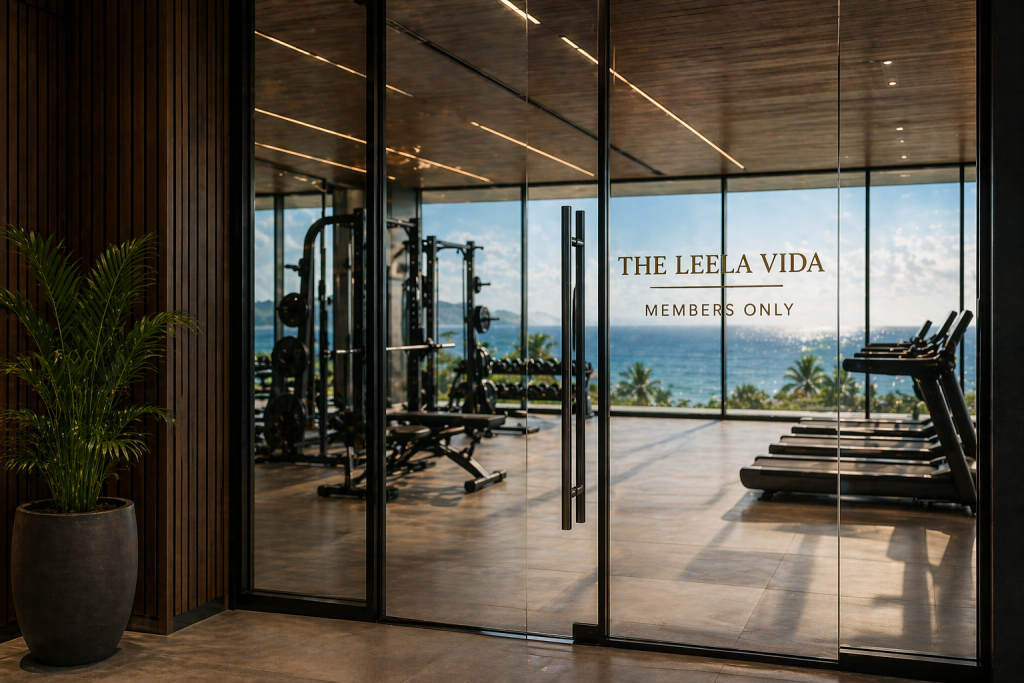
Illustration for conceptual purposes. Actual facilities and experiences at The Leela Vida may vary.
At a certain level, the question is not whether you can train in a public gym. You can. The more relevant question is whether the environment supports the way you work, recover, and maintain consistency. For professionals asking are private gyms worth it, the real calculation is rarely about access to equipment alone. It is about whether the setting protects time, attention, and routine.
A private gym changes the conditions around training. That distinction matters more than most people admit. If your day is tightly structured, interruptions carry a cost. Noise, overcrowding, waiting for equipment, inconsistent cleanliness, casual conversation, and a general lack of order do not just make training less pleasant. They reduce the likelihood that training happens as planned, at the standard required, on a sustained basis.
Are private gyms worth it when time is limited?
For busy professionals, time is usually the deciding factor. A lower monthly membership at a public facility can look efficient on paper. In practice, the cheaper option often creates friction at every stage. Parking takes longer. The floor is crowded. Equipment is in use. The atmosphere is unfocused. Sessions stretch beyond the time you allocated, or they become compromised enough that you stop treating them as non-negotiable.
A private environment removes much of that drag. You move through the session directly. You train without delay. You leave without having spent additional energy managing the setting itself. That may seem minor, but over months it changes adherence. And adherence, not intention, is what produces results.
This is where the value of private space becomes more concrete. If a public gym saves money but costs consistency, it is not necessarily the lower-cost option. For someone who treats physical performance as part of professional capacity, inefficiency in training has a broader effect than a line item on a membership bill.
What you are really paying for
People often frame private gyms as a premium version of the same service. That is not quite accurate. The best private environments are not simply nicer rooms with fewer people. They are structured to reduce variance.
That means a controlled number of members, predictable access, quieter surroundings, and a standard of upkeep that does not fluctuate with heavy public use. In some cases, it also means recovery, assessment, work areas, and nutrition are integrated into the same environment. When that happens, the value is no longer limited to the workout itself. The entire day becomes easier to organize.
For a professional audience, this is the key distinction. The value of a private gym is operational. It protects the conditions required for repeatable output. You are paying for fewer decisions, fewer interruptions, and less fragmentation.
That does not make private gyms universally worth it. It makes them worth it for people who experience environment as a performance variable rather than a background detail.
When a private gym is probably worth it
A private gym tends to justify its cost when your training is part of a larger system. If you care about body composition, recovery quality, energy management, and cognitive clarity, your environment matters. If your day includes work blocks, calls, meetings, and high-stakes decision-making, training cannot sit in isolation. It has to fit cleanly into the rest of the schedule.
That is where a controlled setting has practical value. You arrive, train, recover, eat appropriately, and return to work without changing rhythm. There is less transition, less noise, and less wasted movement across your day.
Privacy is another factor people understate. Some individuals do not care who is around them. Others train better when they are not navigating the social dynamics of a public room. That is not vanity or preference for exclusivity. It is simply recognition that attention is finite. The less of it you spend on your surroundings, the more of it remains available for the work itself.
In Barbados, where many professionals and long-stay residents structure their schedules around both business and health, this type of integrated environment can be especially useful. The Leela Vida reflects that model – not as a public gym, but as a private performance setting where training, recovery, workspace, and nutrition sit within one controlled routine.
When a private gym is not worth it
There are clear cases where the answer is no. If you are self-directed, flexible with your schedule, and able to train effectively during off-peak public hours, a standard gym may be sufficient. If your primary concern is basic access to equipment and you are not affected by crowding or noise, you may see little added value in paying more.
The same applies if you are early in the process and still building consistency. A private gym does not create discipline on its own. It can support discipline, but it cannot replace it. If you are not yet using the gym regularly, upgrading the environment may be less important than building the habit.
There is also the question of actual use. Some private facilities justify a premium because they provide more than exercise space. But if you only use a small portion of what is offered, the math changes. A person who trains twice a week for 40 minutes and leaves may not need recovery amenities, workspace integration, or body metrics. In that case, a simpler solution may be appropriate.
The trade-off most people miss
The usual comparison is price versus amenities. The more useful comparison is friction versus continuity.
A public gym can offer more equipment, more classes, and a lower fee. But if the environment is unpredictable, your routine remains vulnerable. A private gym can offer less variety on paper while delivering better consistency in practice. For many professionals, consistency is the more valuable asset.
This is especially true when training supports more than appearance. If you use physical training to maintain energy, regulate stress, improve sleep, and preserve decision-making quality, then the environment around that training carries strategic weight. The fewer points of disruption, the easier it is to protect long-term performance.
That is why the question are private gyms worth it does not have a universal answer. It depends on whether you are buying access or buying structure.
How to decide without overcomplicating it
If you are evaluating whether a private gym makes sense, ask a narrower set of questions.
Do you regularly lose time in public facilities? Does the environment affect your willingness to train? Do delays, noise, and crowding make sessions less effective? Would an integrated setting help you move from training to work or recovery with less disruption? And most importantly, does a more controlled environment increase the likelihood that you stay consistent over the next year, not just the next month?
If the answer to most of those questions is yes, a private gym is likely worth serious consideration.
If the answer is no, there is no reason to force the decision. Public facilities remain adequate for many people. The right choice is the one that matches the standard you actually require, not the one that sounds more impressive.
Are private gyms worth it for long-term results?
They can be, but only when the environment solves a real problem. The strongest case for a private gym is not luxury. It is control. Control over noise, access, privacy, routine, and the flow of the day.
Long-term results come from repeated execution in stable conditions. If a private environment gives you that, the value is clear. If it does not materially change how you train or recover, it is simply a more expensive membership.
Most decisions about health are framed around motivation. For serious professionals, structure is usually more reliable. Choose the setting that makes discipline easier to maintain, and the answer tends to become obvious.