
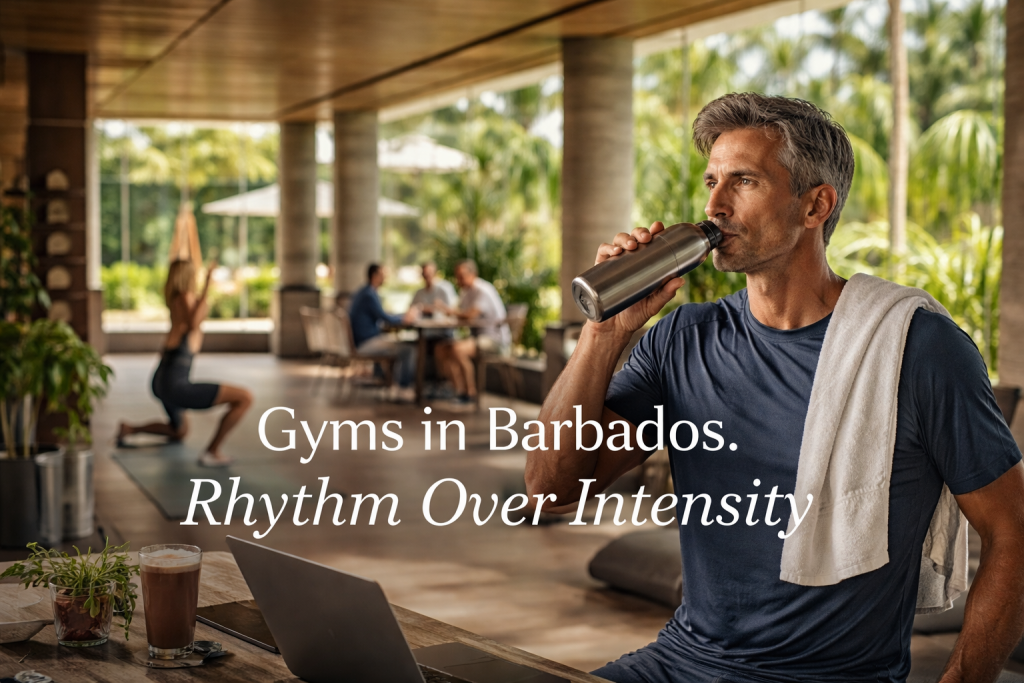
Digital illustration of the intended design and atmosphere. Final layouts and finishes may vary
High performance is not built on bursts of effort.
It is built on rhythm.
Gyms in Barbados. Most professionals do not struggle because they lack ambition.
They struggle because their days lack structure.
Late nights follow early mornings.
Work spills into recovery time.
Training competes with meetings.
Meals happen when they fit, not when they support the body.
Nothing breaks immediately.
Performance declines quietly.
High performers eventually recognize this pattern.
They stop chasing intensity.
They start protecting rhythm.
What Rhythm Means in a High-Performance Life
Rhythm is not speed.
It is not urgency.
It is not volume.
Rhythm is repeatability.
You know how the day begins.
You know where you go.
You know what happens next.
You know when the day ends.
The body responds to this predictability.
So does the mind.
Energy stabilizes.
Focus lasts longer.
Decisions feel lighter.
This is why high performers build routines that travel with them.
Not because they lack flexibility.
Because rhythm protects output.
Why Intensity Eventually Fails
Intensity feels productive in the short term.
Hard workouts.
Long hours.
Compressed schedules.
For a while, results improve.
Then recovery lags behind effort.
Sleep becomes inconsistent.
Training quality drops.
Mental sharpness fades.
Intensity creates peaks.
Peaks require recovery valleys.
High performers do not want peaks and valleys.
They want steady output.
They need days that feel similar enough to support consistency.
Not identical, but familiar.
Rhythm removes volatility.
It replaces push with flow.
The Hidden Cost of Irregular Days
An irregular day demands constant adjustment.
You wake unsure of timing.
You negotiate when to train.
You delay meals.
You shift work blocks.
Each adjustment costs energy.
Not physical energy.
Cognitive energy.
By mid-day, the day already feels heavy.
Not because of workload.
Because of constant reorientation.
High performers notice this first in the margins.
Training gets skipped.
Recovery shortens.
Work stretches into evenings.
The problem is not discipline.
The problem is the environment.
Why Environment Shapes Rhythm More Than Willpower
People often believe rhythm comes from self control.
It does not.
Rhythm comes from design.
If your environment requires planning at every step, rhythm collapses.
If every activity involves travel, scheduling, and coordination, rhythm erodes.
When training is far away, it gets postponed.
When recovery is optional, it gets skipped.
When food requires decision making, choices accumulate.
The simplest environments win over time.
Not because they offer less.
Because they demand less.
High performers understand this instinctively.
They choose environments that carry structure for them.
Why Integrated Environments Matter
An integrated environment reduces friction.
You arrive once.
The day unfolds.
Training does not require a separate journey.
Recovery does not require a separate booking.
Work does not require relocation.
Food does not require planning.
The body stays warm.
The mind stays oriented.
This continuity matters more than people realize.
When transitions disappear, rhythm appears.
Not because effort increases.
Because resistance decreases.
This is why private clubs, executive compounds, and controlled environments outperform fragmented setups for this audience.
The goal is not to do more.
The goal is to reset less.
How The Leela Vida Serves This Need
The Leela Vida was designed as a daily operating environment.
Not as a gym.
Not as a café.
Not as a workspace.
It is a place where the day holds together.
Members arrive once.
The rhythm begins immediately.
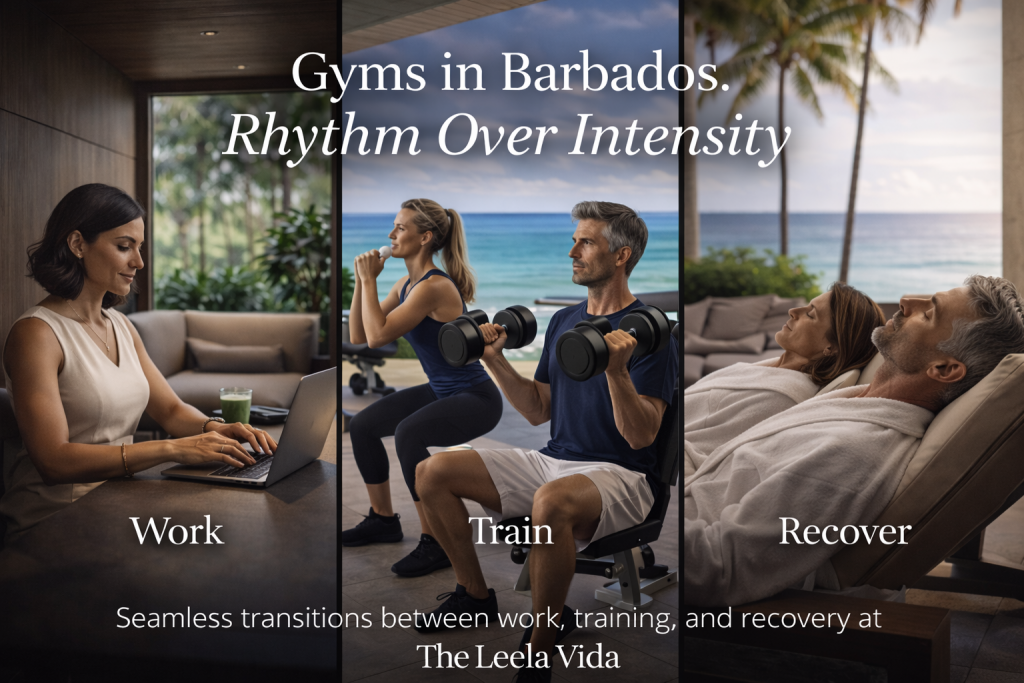
Training happens without delay or negotiation.
Recovery follows without interruption.
Work continues without relocation.
Food is available without debate.
There is no rush to leave.
There is no pressure to move on.
The environment supports continuity.
This is not accidental.
It is intentional.
Every space exists to reduce transition cost.
Every flow decision exists to protect rhythm.
Why This Matters to the Target Market
The Leela Vida is designed for a specific professional profile.
Executives.
Founders.
Partners.
Senior advisors.
Long stay expatriates.
Welcome Stamp professionals.
These individuals already manage complexity all day.
They do not want personal routines to require management.
They value predictability more than novelty.
They value calm more than stimulation.
They value reliability more than variety.
They want an environment that absorbs complexity for them.
The Leela Vida does this quietly.
Same arrival.
Same calm.
Same structure.
Different work.
Different training.
Different outcomes.
The rhythm stays constant.
Why Rhythm Improves More Than Productivity
Rhythm improves mood.
Rhythm improves sleep.
Rhythm improves training quality.
When the day feels predictable, the nervous system relaxes.
Breathing slows.
Focus deepens.
Training feels lighter, even when effort remains high.
Recovery improves because it happens on time.
Work quality improves because attention lasts longer.
These benefits appear subtle at first.
They compound quickly.
This is why people who find rhythm rarely give it up.
Not because it is exciting.
Because it works.
Why Rhythm Supports Longevity
Careers last decades.
Bodies require care over decades.
Irregular intensity wears joints.
Late nights disrupt hormones.
Inconsistent routines strain recovery.
Rhythm protects longevity.
It allows effort without exhaustion.
Ambition without burnout.
High performers understand this tradeoff.
They do not chase short term output at the expense of long term capacity.
They choose environments that support repeatable days.
The Leela Vida was created with this horizon in mind.
Not for short bursts of performance.
For sustained output over years.
Why This Is Not About Minimalism
This is not about doing less.
It is about doing things in the right order.
Training still happens.
Work still happens.
Recovery still happens.
They simply happen without friction.
The Leela Vida does not remove ambition.
It removes obstacles.
It does not simplify goals.
It simplifies the path.
Why High Performers Stay Once They Find Rhythm
Once rhythm is established, it becomes protective.
Members stop negotiating their day.
They stop debating when to train.
They stop delaying recovery.
The environment carries the structure.
This is why high performers stay loyal to places that feel steady.
Not because of features.
Because of how the day feels.
The Leela Vida is designed to feel the same on the hundredth visit as on the first.
That consistency builds trust.
Why Rhythm Is the New Performance Advantage
The future of performance is not louder.
Not faster.
Not harder.
It is steadier.
High performers no longer chase extremes.
They design days that repeat.
They protect rhythm because rhythm protects capacity.
The Leela Vida exists to serve this reality.
Not as motivation.
Not as a solution to a problem.
As a place where the day works the same way, every time.
That reliability is the advantage.
The Leela Vida
Source: https://pmc.ncbi.nlm.nih.gov/articles/PMC5579396/
What does rhythm mean in a high performance lifestyle?
Rhythm means repeatable days. Similar arrival times. Predictable flow. Fewer resets. This supports steady output over months and years.
Why do executives compare gyms in Barbados as lifestyle environments
High performers evaluate how a place supports the whole day. Not equipment. Not classes. They look for structure, calm, and time efficiency.
Why do high performers prioritize rhythm over intensity?
Intensity creates peaks and crashes. Rhythm creates stability. Stable days protect focus, sleep, and recovery. Output stays consistent.
How does an integrated environment support rhythm?
Integration removes transitions. Training, recovery, work, and food sit in one place. The day flows without interruption.
How does The Leela Vida serve professionals long term?
It anchors the day. One arrival. One rhythm. Predictable flow. Members operate without managing logistics. Performance follows naturally.