
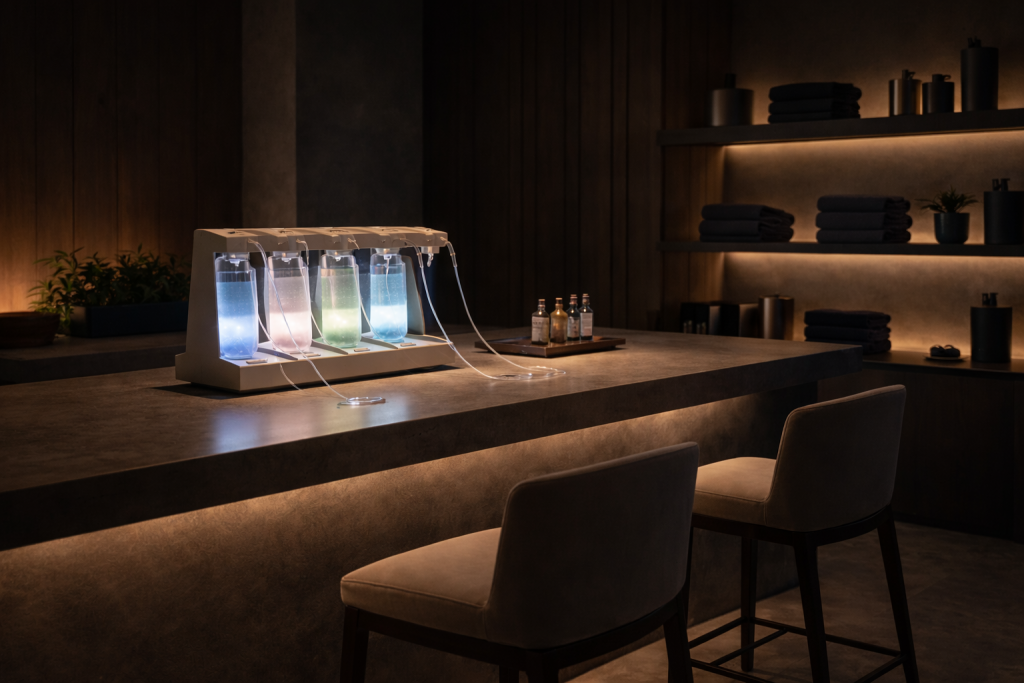
Illustration for conceptual purposes. Actual facilities and experiences at The Leela Vida may vary.
The Oxygen KPI
VO2 Max measures how efficiently your body uses oxygen under load, and this single metric defines your ability to sustain performance over time. It influences energy stability, cardiovascular strength, brain oxygenation, and recovery capacity.
For executives, this is not a theoretical concept. It is a direct indicator of how long you sustain high-level output without decline. When oxygen delivery is efficient, energy remains stable and performance remains consistent. When it is not, fatigue appears earlier and output drops.
This is why VO2 Max is increasingly treated as a core performance KPI rather than a fitness metric. It reflects the capacity of the entire system, not the heart or lungs alone. It determines how effectively your body supports long working hours, decision-making under pressure, and sustained cognitive demand.
In a high-performance environment, this becomes a measurable advantage.
Cognitive Performance Link
The brain depends heavily on oxygen to function efficiently. Every process linked to focus, clarity, and decision-making depends on how well oxygen is delivered and used. When VO2 Max is low, this system becomes a limiting factor. Cognitive fatigue appears earlier. Focus becomes inconsistent. The quality of decisions declines as the day progresses.
This explains a common pattern seen in professionals. Strong performance in the morning followed by reduced clarity in the afternoon is often blamed on workload. In many cases, the deeper issue is physiological capacity. As VO2 Max improves, the brain receives more consistent oxygen support. This supports clearer thinking, steadier focus, and reduced mental fatigue across longer periods. For executives, founders, and senior professionals, this matters because cognitive output is part of the job.
From Reactive to Measurable
Traditional health models are reactive. Annual checkups and blood markers identify issues after they appear. They do not provide a system for improving performance in real time. VO2 Max introduces a proactive, measurable approach. It identifies capacity before decline becomes visible. It gives you a baseline. It gives you a direction. It gives you a metric you improve through structured training.
This aligns with how high-performing people already make decisions in business. Data drives strategy. Progress gets reviewed. Inputs get adjusted. Outcomes get measured. The same logic applies to physical performance. You do not wait for decline. You build capacity before you need it.
Integrated Diagnostics: Build From a Clear Baseline
VO2 Max conditioning works best when it starts with a proper baseline. Aerobic capacity tells one part of the story. Body structure, posture, muscle balance, and composition tell the rest.
At The Leela Vida, performance training connects with data-driven assessment. This includes 3D body composition and posture analysis, allowing members to understand how their body is built, how it moves, and where improvement is needed.
This matters because VO2 Max does not improve in isolation. Poor posture can affect breathing mechanics. Low lean mass can reduce metabolic efficiency. Imbalances can limit training quality. Excess body fat can increase the oxygen cost of movement.
A baseline assessment helps convert training from guesswork into a structured plan. You see where you are starting. You identify what limits performance. You measure change over time.
For a busy professional, this saves time. It directs effort toward the areas with the greatest return.
The Executive Capacity Gap
A consistent pattern exists among high-performing individuals. Cognitive demand is high, but aerobic capacity is often underdeveloped. This creates a gap between what the brain demands and what the body sustains. Over time, this imbalance leads to energy instability, slower recovery, and reduced output.
The effects begin quietly. Midday fatigue increases. Stimulant use becomes more frequent. Workouts become inconsistent. Recovery takes longer. The body starts to lag behind the level of professional demand placed on it. This is not a failure of discipline. It is a failure of structure.
Without addressing aerobic capacity, performance remains vulnerable. With the right conditioning system, you build a stronger base for work, training, and recovery.
Training VO2 Max Properly
Improving VO2 Max requires structure. It begins with zone 2 conditioning. This controlled, steady-state training builds mitochondrial capacity and improves the body’s ability to use oxygen efficiently. It creates the foundation for endurance, energy stability, and long-term consistency.
Once this base is established, targeted intervals are added. These short, higher-intensity efforts increase peak oxygen uptake and push the system to adapt.Strength training supports the process by preserving muscle mass, improving metabolic efficiency, and reinforcing the physical structure needed for sustained performance.
Together, these elements create a complete training model.
Zone 2 builds the base.
Intervals raise the ceiling.
Strength training protects the system.
Without structure, progress is limited. With structure, improvement becomes measurable and repeatable.
The Leela Vida System
The environment determines whether the system lasts.
Most gyms introduce noise, crowding, inconsistency, and friction. These variables reduce adherence and limit results. They are not designed for high-performing individuals who need control, privacy, and precision.
At The Leela Vida, VO2 Max conditioning sits within a broader performance system that connects training, diagnostics, recovery, and workspace.
Members train inside an oceanfront fitness center in Barbados built for focused performance. They move into recovery protocols designed to support adaptation. They then transition into a private office workspace in Barbados without leaving the environment.
This matters because performance is not created by one workout. It is created by a system you repeat.
Train.
Recover.
Work.
Measure.
Refine.
This integrated model reduces cognitive load and protects consistency. It supports the professional who needs physical energy, mental clarity, and structured recovery in one environment.
VO2 Max is the metric. The system is what improves it.