Red Light Therapy Gym: Is It Worth Adding?
A red light therapy gym can support recovery, skin health, and training consistency – if the protocol, equipment, and environment are right.
Red Light Therapy Gym: Is It Worth Adding? Read More »
A red light therapy gym can support recovery, skin health, and training consistency – if the protocol, equipment, and environment are right.
Red Light Therapy Gym: Is It Worth Adding? Read More »
Healthy deli meals can support focus, training, and recovery when built with the right balance of protein, fiber, and steady energy.
Healthy Deli Meals That Support Performance Read More »
A private members club for professionals offers structure, privacy, and performance support for work, training, recovery, and daily clarity.
Private Members Club for Professionals Read More »
Executive workspaces for professionals support focus, privacy, and output by reducing friction and protecting routine across the working day.
Executive Workspaces for Professionals Read More »
Illustration for conceptual purposes. Actual facilities and experiences at The Leela Vida may vary. Most high-performing professionals approach training with the same mindset they apply to business. They increase intensity, push harder, and assume more effort leads to better results. This approach works in commercial environments where output scales with effort. In physiology, the outcome is different. High-intensity training increases stress, elevates cortisol, and places a greater demand on recovery. When combined with an already demanding lifestyle, it reduces consistency and long-term performance. Executives do not need more intensity. They need stability. Training should support energy, not disrupt it. This is where zone 2 training becomes essential. It provides a structured, controlled method to improve fat loss, energy, and long-term performance without increasing systemic stress. THE TRAINING ERROR Most professionals train in short bursts of high intensity, believing this approach produces faster results. While this can create temporary improvements, it often leads to fatigue and inconsistency. Energy fluctuates, recovery becomes unpredictable, and training is interrupted. Over time, progress slows or stops completely. For an executive, this approach is inefficient. Performance is required across the entire day, not just during a workout. A system that creates energy crashes and inconsistent recovery works against this requirement. Training must align with lifestyle demands, not compete with them. WHAT ZONE 2 TRAINING IS Zone 2 training is a controlled form of steady-state cardio performed at a sustainable intensity. It typically operates between 60 to 70 percent of maximum heart rate. At this level, breathing remains steady, and the effort can be maintained for extended periods without strain. This form of training requires discipline. The challenge is not pushing harder, but maintaining control. Most individuals move too quickly and unintentionally increase intensity, turning a controlled session into a stressful one. Zone 2 training requires awareness and restraint, which is why it produces consistent results over time. METABOLIC EFFICIENCY AND FAT LOSS Zone 2 training improves how the body uses energy. At this intensity, the body relies more heavily on fat as a fuel source. Over time, this increases metabolic efficiency and supports consistent fat loss without extreme dieting or excessive training. This also stabilizes energy levels throughout the day. Instead of relying on glucose spikes, the body becomes more efficient at sustained energy production. For professionals, this results in fewer energy crashes and improved clarity. The outcome is not rapid transformation, but steady, controlled progress that can be maintained. ENERGY, STRESS, AND THE NERVOUS SYSTEM High-intensity training increases stress on the nervous system. When combined with the pressures of executive life, this can lead to overload. Symptoms often include poor recovery, reduced sleep quality, and lower daily performance. Zone 2 training supports the nervous system rather than taxing it. It helps regulate heart rate patterns, improves recovery, and creates a stable physiological state. This allows training to function as a support mechanism rather than an additional stressor. Over time, this leads to improved resilience and more consistent output. CONSISTENCY OVER INTENSITY The primary advantage of zone 2 training is consistency. It allows for frequent training without excessive fatigue, making it easier to maintain a structured routine. This consistency leads to accumulation, and accumulation drives results. High-intensity training often results in missed sessions due to fatigue or time constraints. Zone 2 training removes this barrier. It supports a routine that can be sustained over the long term. For professionals, this structured consistency is more valuable than short periods of high effort. THE LEELA VIDA APPROACH Most training environments are not designed for controlled performance. They are often crowded, loud, and distracting, which makes discipline difficult. This creates friction and reduces the effectiveness of any training approach. The Leela Vida is structured differently. The environment is quiet, controlled, and designed to reduce cognitive load, allowing members to focus fully on training and recovery. Training, recovery, and workspace are integrated into one system, enabling professionals to move through their routine without disruption. Zone 2 training fits naturally within this structure. It supports a disciplined approach to performance where energy is preserved, recovery is prioritized, and output remains consistent throughout the day. PRACTICAL APPLICATION To implement zone 2 training effectively, begin by identifying your target heart rate range. Use controlled equipment such as a treadmill, bike, or elliptical, and maintain a steady pace for 30 to 45 minutes. Avoid sudden increases in intensity and focus on maintaining a consistent rhythm. Track your sessions over time. As efficiency improves, the same effort will produce better results. Energy levels will stabilize, and performance will increase. This approach creates awareness, control, and measurable progress. Zone 2 training is not designed to impress. It is designed to perform.

Zone 2 Training Barbados Read More »
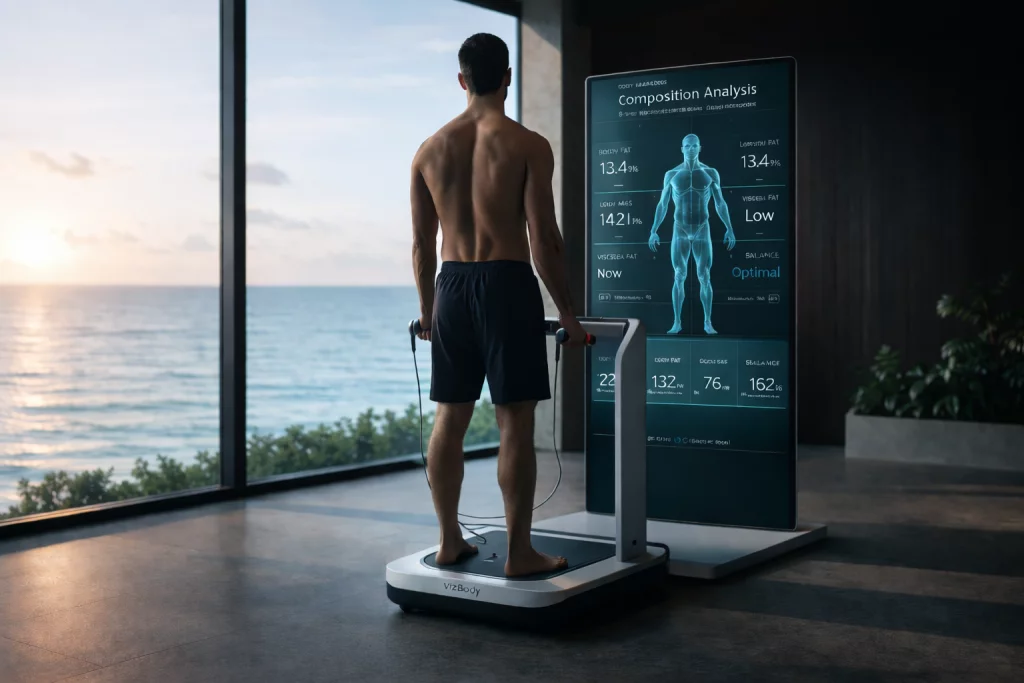
Illustration for conceptual purposes. Actual facilities and experiences at The Leela Vida may vary. Why Scale Weight Fails Executives Most professionals still rely on body weight as the primary measure of progress. This approach is outdated and lacks precision. A scale does not distinguish between fat, muscle, water retention, or inflammation. As a result, it produces misleading signals that can lead to poor decisions. Two individuals can weigh the same yet operate at completely different levels of performance, energy, and resilience. For an executive, this level of ambiguity is unacceptable. A drop in weight may appear positive, but without context, it often reflects muscle loss rather than fat reduction. This has direct consequences. Muscle loss reduces metabolic efficiency, lowers strength, and weakens long-term physical stability. Over time, this leads to fatigue, slower recovery, and reduced output. Tracking weight alone removes the detail required to make informed adjustments, making it a weak and unreliable metric for anyone focused on performance. What Body Composition Reveals Body composition analysis provides a structured breakdown of the body into measurable components. These include body fat percentage, lean muscle mass, visceral fat levels, and hydration status. Each of these metrics offers insight into how the body is functioning beneath the surface. Instead of relying on appearance or assumptions, you gain a clear view of what is actually changing over time. This allows for targeted decision making. If fat is not reducing, training or nutrition can be adjusted. If muscle mass is declining, recovery and resistance training can be corrected. This removes guesswork entirely. Over time, this level of precision creates consistent improvement, where each adjustment is based on data rather than perception. For individuals who value control, this becomes a necessary standard. The Executive Performance Advantage High-performing professionals operate in environments where data drives decisions. Financial performance, operational efficiency, and strategic planning are all built on measurable inputs. Health should follow the same principle. Without data, there is no control. Without control, results become inconsistent. Body composition tracking introduces structure into health. It aligns physical performance with the same disciplined mindset applied in business. When an executive understands how their body is changing at a detailed level, they can make decisions with confidence. Training becomes more effective. Nutrition becomes purposeful. Recovery becomes strategic. This creates alignment between physical capacity and professional demands. Why Precision Drives Better Outcomes Subjective measurement leads to inconsistent results. Relying on how you feel or how you look introduces variability that cannot be controlled. Energy levels fluctuate. Visual changes are gradual and often misleading. Without clear data, it becomes difficult to determine whether progress is being made or lost. Precision changes this entirely. Measurable changes in body fat, muscle mass, and metabolic efficiency provide clear direction. For example, reducing body fat while maintaining or increasing muscle creates a stronger, more efficient system. This improves energy stability, supports cognitive clarity, and enhances recovery capacity. These changes are not immediate, but they compound over time, creating long-term advantages that support sustained performance. The Role of Structured Assessment The environment in which measurement takes place is critical. Inconsistent conditions produce unreliable data. Public gyms and general fitness environments rarely offer the control required for accurate tracking. Variations in hydration, timing, and equipment can distort results, making it difficult to identify real progress. A structured assessment protocol eliminates this variability. Measurements are taken under consistent conditions, using the same equipment and timing. This produces reliable data that can be compared over time. For professionals who rely on accuracy in every other area of life, this level of consistency is expected. It ensures that every decision made is based on clear, repeatable information. A New Standard for Measurement Body composition analysis shifts the focus from appearance to performance. It replaces estimation with data and removes emotional bias from the process. This creates a more disciplined approach to health, where decisions are based on measurable outcomes rather than assumptions. At The Leela Vida, this approach is integrated into a broader system. Training, recovery, and measurement operate together within a controlled environment designed for high-performing individuals. This reflects a wider shift in the market, where professionals seek environments that reduce cognitive load and support structured performance. The objective is not short-term change, but sustained, measurable improvement that aligns with long-term health and professional output.
Body Metrics Barbados Read More »
Illustration for conceptual purposes. Actual facilities and experiences at The Leela Vida may vary. Time Is the Constraint Time is the primary constraint for high performers. Not motivation. Not knowledge. Not access. Time. In Barbados, most gyms operate on fixed schedules with early closing hours and predictable congestion during peak times. This structure supports the general market but fails the executive profile. High-performing professionals do not operate on fixed timelines. Their day is shaped by decisions, shifting priorities, and constant demand. A gym that dictates when you train introduces friction into an already complex schedule. A 24 hour gym removes that friction and aligns fitness with real life. The Executive Schedule Reality Executives do not follow a linear day. Meetings extend without warning. Calls shift across time zones. Travel disrupts routine. This creates unpredictable gaps where training must fit in precisely. Without flexibility, sessions are missed, and consistency breaks. Once consistency breaks, performance declines. High performers do not rely on motivation to compensate. They rely on systems that remove obstacles entirely. A 24 hour gym allows training to occur when the opportunity appears, not when the facility permits it. Whether it is early morning before the day begins or late evening after work ends, access remains constant. This level of flexibility supports adherence and allows fitness to integrate into demanding schedules without compromise. Why Standard Gyms Fail The current gym model in Barbados is built around volume and accessibility for the general population. Opening hours, shared equipment, and peak traffic define the experience. This model aligns with pricing in the BD$292 to BD$350 range, where the offering is simple access rather than performance optimization. For an executive, this creates inefficiency. Waiting for equipment, adjusting workouts around crowds, and losing sessions due to closing times all reduce consistency. These small disruptions accumulate. Over time, they lead to reduced results and lower adherence. A system that introduces friction cannot support high-level performance. Training Around Energy Executives perform best when training aligns with energy, not time. Early morning sessions provide clarity and structure before decision-making begins. Midday sessions act as a reset, reducing stress and restoring focus. Evening sessions support recovery and nervous system balance after a long day. These windows do not align with standard gym schedules. A 24 hour gym allows training at the exact moment physical and mental energy are optimal. This creates precision in routine. Training becomes consistent because it fits naturally into the day, rather than being forced into a limited time window. Control Over Convenience The value of a 24 hour gym is often misunderstood. It is not about convenience. It is about control. Executives do not seek more options. They seek fewer constraints. Control means no dependency on opening hours, no need to avoid peak traffic, and no compromise on routine. This control creates stability. Stability drives consistency. Consistency drives results. In a high-performance environment, removing variables is more valuable than adding features. A 24 hour gym provides that control, allowing individuals to operate on their own schedule without disruption. The Private Club Advantage The shift in Barbados is moving toward private, controlled environments designed for high-performing individuals. These spaces prioritize privacy, discipline, and consistency over volume. They remove crowding, reduce noise, and protect the training environment. A 24 hour private gym completes this model. It combines unrestricted access with a controlled, quiet environment. This allows professionals to train, recover, and maintain routine without compromise. The result is not convenience. It is a system that supports long-term performance, energy stability, and sustained output at the highest level.
24 Hour Gym Barbados Read More »
Illustration for conceptual purposes. Actual facilities and experiences at The Leela Vida may vary. The Oxygen KPI VO2 Max measures how efficiently your body uses oxygen under load, and this single metric defines your ability to sustain performance over time. It influences energy stability, cardiovascular strength, brain oxygenation, and recovery capacity. For executives, this is not a theoretical concept. It is a direct indicator of how long you can operate at a high level without decline. When oxygen delivery is efficient, energy remains stable and output is consistent. When it is not, fatigue appears earlier and performance drops. This is why VO2 Max is increasingly treated as a core performance KPI rather than a fitness metric. It reflects the capacity of the entire system, not just the heart or lungs. It determines how effectively your body can support long working hours, decision-making under pressure, and sustained cognitive demand. In a high-performance environment, this becomes a measurable advantage that compounds over time. Cognitive Performance Link The brain depends heavily on oxygen to function efficiently. Every process that requires focus, clarity, and decision-making is directly linked to how well oxygen is delivered and utilized. When VO2 Max is low, this system becomes a limiting factor. Cognitive fatigue appears earlier, focus becomes inconsistent, and the quality of decisions declines as the day progresses. This explains a common pattern seen in professionals. Strong performance in the morning followed by reduced clarity in the afternoon is often blamed on workload. In reality, it is frequently a limitation in physiological capacity. As VO2 Max improves, the brain receives more consistent oxygen supply, allowing for sustained cognitive output across longer periods. This creates sharper thinking, better focus, and reduced mental fatigue, all of which are critical for executive performance. From Reactive to Measurable Traditional health models are reactive. Annual checkups and blood markers identify issues after they appear, but they do not provide a system for improving performance in real time. This approach is sufficient for general health but inadequate for individuals operating at a high level. VO2 Max introduces a proactive, measurable approach. It identifies capacity before decline becomes visible and provides a clear baseline for improvement. This allows professionals to track progress, adjust training, and measure outcomes with precision. It aligns with how decisions are made in business, where data drives strategy. Instead of reacting to decline, you build capacity in advance and maintain control over performance. The Executive Capacity Gap A consistent pattern exists among high-performing individuals. Cognitive demand is high, but aerobic capacity is often underdeveloped. This creates a gap between what the brain demands and what the body can sustain. Over time, this imbalance leads to energy instability, reduced recovery, and lower overall output. The effects are subtle at first but become more pronounced. Midday fatigue increases, reliance on stimulants becomes more common, and the ability to sustain long working hours declines. This is not due to lack of effort or discipline. It is due to a lack of structure in physical conditioning. Without addressing aerobic capacity, performance cannot be sustained at the highest level. Training VO2 Max Properly Improving VO2 Max requires a structured approach. It begins with zone 2 conditioning, where controlled, steady-state training builds mitochondrial capacity and improves the body’s ability to use oxygen efficiently. This forms the foundation for long-term endurance and energy stability. Once this base is established, targeted intervals are introduced. These short, high-intensity efforts increase peak oxygen uptake and push the system to adapt. Strength training supports this process by preserving muscle mass and improving metabolic efficiency. Together, these elements create a complete training model that enhances both physical and cognitive performance. Without structure, improvements are limited. With structure, progress becomes measurable and consistent. The Leela Vida System The environment plays a critical role in whether this system is sustained. Most gyms introduce variables such as noise, crowding, and inconsistency, which reduce adherence and limit results. These environments are not designed for high-performing individuals who require control and precision. At The Leela Vida, VO2 Max is integrated into a broader performance system that includes training, recovery, and workspace. Members move from structured training into immediate recovery protocols, then into focused work without disruption. This integrated model reflects a shift toward environments designed to reduce cognitive load and support sustained output. It is not about isolated workouts. It is about creating a system where performance is measured, improved, and maintained over time.
Illustration for conceptual purposes. Actual facilities and experiences at The Leela Vida may vary. Section 1. Motivation Fails. Structure Wins Most people rely on motivation. High performers rely on structure. Motivation fluctuates. Biology does not. Your energy, focus, and recovery follow predictable cycles driven by circadian rhythm, cortisol, and glucose stability. When your day is unstructured, performance becomes random. When your day is structured, performance becomes repeatable. The Leela Vida model is built on this principle. It removes decision fatigue and replaces it with a controlled environment where training, work, and recovery are pre-aligned. This is critical for executives. Cognitive load is already high. Every unnecessary decision reduces output quality. A fixed routine eliminates that friction. Section 2. The First 3 Hours Define the Day The highest performing individuals protect the first 3 hours of the day. This is not preference. It is biology. Cortisol peaks in the morning. This creates natural alertness, focus, and drive. If this window is used correctly, the rest of the day stabilizes. If wasted, the entire day becomes reactive. The structure is simple. Wake at a fixed time. Avoid immediate input such as email or social media. Begin with internal alignment. This includes breathwork, stillness, or meditation. Follow with movement. This can be strength training or controlled cardio. Then fuel the body with stable nutrition. This sequence creates a controlled nervous system. It prevents cortisol spikes later in the day. It anchors mental clarity before external demands begin. This is why environments that support early routine execution outperform traditional gyms or coworking spaces. They remove friction between intention and action. Section 3. Energy Is Managed in Blocks, Not Hours Time management is outdated. Energy management drives performance. The brain operates in cycles of approximately 90 to 120 minutes. After this, focus declines. Most people ignore this and push through fatigue. This reduces output quality. High performers structure their day into energy blocks. Deep work sessions are scheduled in the morning and early afternoon when cognitive capacity is highest. Each block is protected. No interruptions. No multitasking. Between blocks, recovery is introduced. This includes movement, hydration, or short resets. The Leela Vida workspace model follows this principle. Four hour booking blocks are intentional. They align with two deep work cycles. This creates sustained output without burnout. Section 4. Recovery Is Not Optional. It Is Strategic Most people treat recovery as passive. High performers treat it as active. Recovery determines how quickly the body and brain return to baseline. Without structured recovery, stress accumulates. This leads to reduced focus, poor sleep, and inconsistent performance. The most effective routines integrate recovery daily. This includes cold exposure, heat therapy, and light-based interventions. These methods reduce inflammation, improve circulation, and stabilize the nervous system. The key is timing. Recovery is most effective when placed after training or high cognitive output. This creates a feedback loop. Stress is introduced. Recovery is applied. Adaptation improves. Over time, capacity increases. This is the difference between short bursts of productivity and sustained high performance. Section 5. The Environment Determines Compliance Discipline is often misunderstood. It is not willpower. It is environment design. If your environment creates friction, compliance drops. If your environment removes friction, consistency increases. This is why most people fail to maintain routines at home or in public gyms. Too many variables. Too many distractions. A controlled environment changes behavior without effort. At The Leela Vida, the structure is built into the space. Training, work, and recovery are integrated. Movement between each is seamless. There is no decision gap. This reduces cognitive load and increases adherence. The result is consistency. Consistency leads to measurable progress. This is also why membership is capped. Overcrowding destroys routine integrity. Space and access are part of performance design. Section 6. The 24 Hour Loop Creates Long Term Output A high performance routine is not a morning habit. It is a 24 hour loop. The evening determines the next morning. Late meals, excessive stimulation, and irregular sleep disrupt the entire cycle. The goal is stability. Fixed sleep time. Controlled light exposure. Reduced stimulation in the final hours of the day. This supports deep sleep. Deep sleep drives recovery, hormone balance, and cognitive reset. When this loop is consistent, performance compounds. Energy becomes predictable. Focus becomes stable. Output increases without additional effort. This is the foundation of executive performance. Not intensity. Not motivation. Structure repeated daily. This is the shift. From motivation to system. From effort to design. From random output to controlled performance.
The Science of the 24 Hour Routine Read More »
Illustration for conceptual purposes. Actual facilities and experiences at The Leela Vida may vary. Travel Becomes Performance Most travel time is wasted. Hours are spent sitting, waiting, and absorbing noise without intention. Energy drops. Focus declines. The body tightens. By the time you reach your destination, your system is already compromised. This is accepted as normal, but it is not optimal. A gym near Barbados airport changes this completely. It converts idle time into structured performance time. Instead of waiting at the terminal, you move with intention. You train. You recover. You reset. This creates a transition from passive travel to controlled performance. At The Leela Vida, this shift is built into the experience. The environment is designed to support this exact use case for professionals who do not accept wasted time. The 10 Minute Advantage Location is not about convenience. It is about precision. The Leela Vida sits approximately 10 minutes from Grantley Adams International Airport. This creates a defined performance window that can be used intentionally before or after travel. This proximity allows multiple use cases. A 90-minute pre-flight window becomes a structured training and recovery session. A layover becomes productive rather than wasted. A post-flight arrival becomes an opportunity to reset the body immediately. You avoid airport congestion and noise while maintaining control of your schedule. This positioning is not accidental. It is designed to serve individuals who operate on structure and efficiency. Travel Disrupts the System Travel creates measurable disruption in the body. Extended sitting reduces circulation. Muscles tighten. Cortisol levels rise. The nervous system becomes imbalanced. These effects accumulate quickly and impact both physical and cognitive performance. Without intervention, this carries into your next destination. You arrive with reduced energy and compromised focus. A structured session before or after travel corrects this. Strength training restores circulation. Controlled cardio reactivates the system. Movement reduces fatigue. This allows you to maintain continuity rather than restarting every time you travel. Private Environment Matters Most gyms near airports are designed for volume. They are built to accommodate high traffic, not performance. This introduces friction. Crowds, waiting times, and noise disrupt training. You adjust your session based on others. This reduces efficiency and consistency. At The Leela Vida, the environment is controlled. Membership is capped. Space is protected. Equipment is available when needed. There is no crowd pressure. This aligns with the expectations of high-performing professionals who require precision and privacy. The environment removes variability and supports execution. Integrated Work and Transit Flow Travel does not remove responsibility. Work continues. Calls, emails, and decisions remain. Most people attempt this in airport lounges or terminals, where noise and distraction reduce effectiveness. This creates fragmented output. The Leela Vida integrates private work pods into the experience. These are sound-isolated environments with high-speed connectivity and executive seating. You complete work without interruption. You move from training to recovery to focused work in one controlled flow. This integration reflects the demand for environments that reduce cognitive load and support professional output. Recovery and Reset System Training is only one part of the system. Recovery determines how you perform next. Most facilities treat recovery as optional. This reduces the effectiveness of training and slows adaptation. At The Leela Vida, recovery follows immediately after training. Cold plunge reduces inflammation. Infrared sauna improves circulation. Red light therapy supports cellular repair. These are not separate services. They are integrated into a single system. This allows the body to reset quickly before travel. The environment completes the process. The oceanfront setting overlooking Long Beach provides a controlled but open space that supports mental clarity. You leave in a different state than you arrived. This is the real advantage. Not access to a gym, but access to a system that maintains performance across travel.
Gym Near Airport Barbados Read More »