
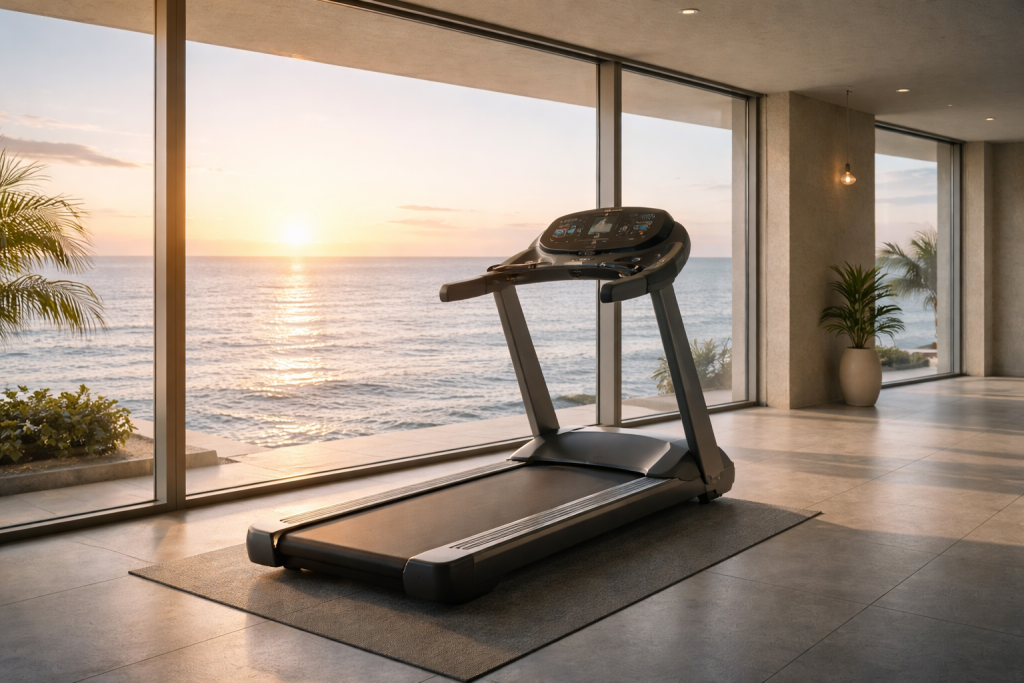
Illustration for conceptual purposes. Actual facilities and experiences at The Leela Vida may vary.
Most high-performing professionals approach training with the same mindset they apply to business. They increase intensity, push harder, and assume more effort leads to better results. This approach works in commercial environments where output scales with effort. In physiology, the outcome is different. High-intensity training increases stress, elevates cortisol, and places a greater demand on recovery. When combined with an already demanding lifestyle, it reduces consistency and long-term performance.
Executives do not need more intensity. They need stability. Training should support energy, not disrupt it. This is where zone 2 training becomes essential. It provides a structured, controlled method to improve fat loss, energy, and long-term performance without increasing systemic stress.
THE TRAINING ERROR
Most professionals train in short bursts of high intensity, believing this approach produces faster results. While this can create temporary improvements, it often leads to fatigue and inconsistency. Energy fluctuates, recovery becomes unpredictable, and training is interrupted. Over time, progress slows or stops completely.
For an executive, this approach is inefficient. Performance is required across the entire day, not just during a workout. A system that creates energy crashes and inconsistent recovery works against this requirement. Training must align with lifestyle demands, not compete with them.
WHAT ZONE 2 TRAINING IS
Zone 2 training is a controlled form of steady-state cardio performed at a sustainable intensity. It typically operates between 60 to 70 percent of maximum heart rate. At this level, breathing remains steady, and the effort can be maintained for extended periods without strain.
This form of training requires discipline. The challenge is not pushing harder, but maintaining control. Most individuals move too quickly and unintentionally increase intensity, turning a controlled session into a stressful one. Zone 2 training requires awareness and restraint, which is why it produces consistent results over time.
METABOLIC EFFICIENCY AND FAT LOSS
Zone 2 training improves how the body uses energy. At this intensity, the body relies more heavily on fat as a fuel source. Over time, this increases metabolic efficiency and supports consistent fat loss without extreme dieting or excessive training.
This also stabilizes energy levels throughout the day. Instead of relying on glucose spikes, the body becomes more efficient at sustained energy production. For professionals, this results in fewer energy crashes and improved clarity. The outcome is not rapid transformation, but steady, controlled progress that can be maintained.
ENERGY, STRESS, AND THE NERVOUS SYSTEM
High-intensity training increases stress on the nervous system. When combined with the pressures of executive life, this can lead to overload. Symptoms often include poor recovery, reduced sleep quality, and lower daily performance.
Zone 2 training supports the nervous system rather than taxing it. It helps regulate heart rate patterns, improves recovery, and creates a stable physiological state. This allows training to function as a support mechanism rather than an additional stressor. Over time, this leads to improved resilience and more consistent output.
CONSISTENCY OVER INTENSITY
The primary advantage of zone 2 training is consistency. It allows for frequent training without excessive fatigue, making it easier to maintain a structured routine. This consistency leads to accumulation, and accumulation drives results.
High-intensity training often results in missed sessions due to fatigue or time constraints. Zone 2 training removes this barrier. It supports a routine that can be sustained over the long term. For professionals, this structured consistency is more valuable than short periods of high effort.
THE LEELA VIDA APPROACH
Most training environments are not designed for controlled performance. They are often crowded, loud, and distracting, which makes discipline difficult. This creates friction and reduces the effectiveness of any training approach.
The Leela Vida is structured differently. The environment is quiet, controlled, and designed to reduce cognitive load, allowing members to focus fully on training and recovery. Training, recovery, and workspace are integrated into one system, enabling professionals to move through their routine without disruption.
Zone 2 training fits naturally within this structure. It supports a disciplined approach to performance where energy is preserved, recovery is prioritized, and output remains consistent throughout the day.
PRACTICAL APPLICATION
To implement zone 2 training effectively, begin by identifying your target heart rate range. Use controlled equipment such as a treadmill, bike, or elliptical, and maintain a steady pace for 30 to 45 minutes. Avoid sudden increases in intensity and focus on maintaining a consistent rhythm.
Track your sessions over time. As efficiency improves, the same effort will produce better results. Energy levels will stabilize, and performance will increase. This approach creates awareness, control, and measurable progress.
Zone 2 training is not designed to impress. It is designed to perform.