
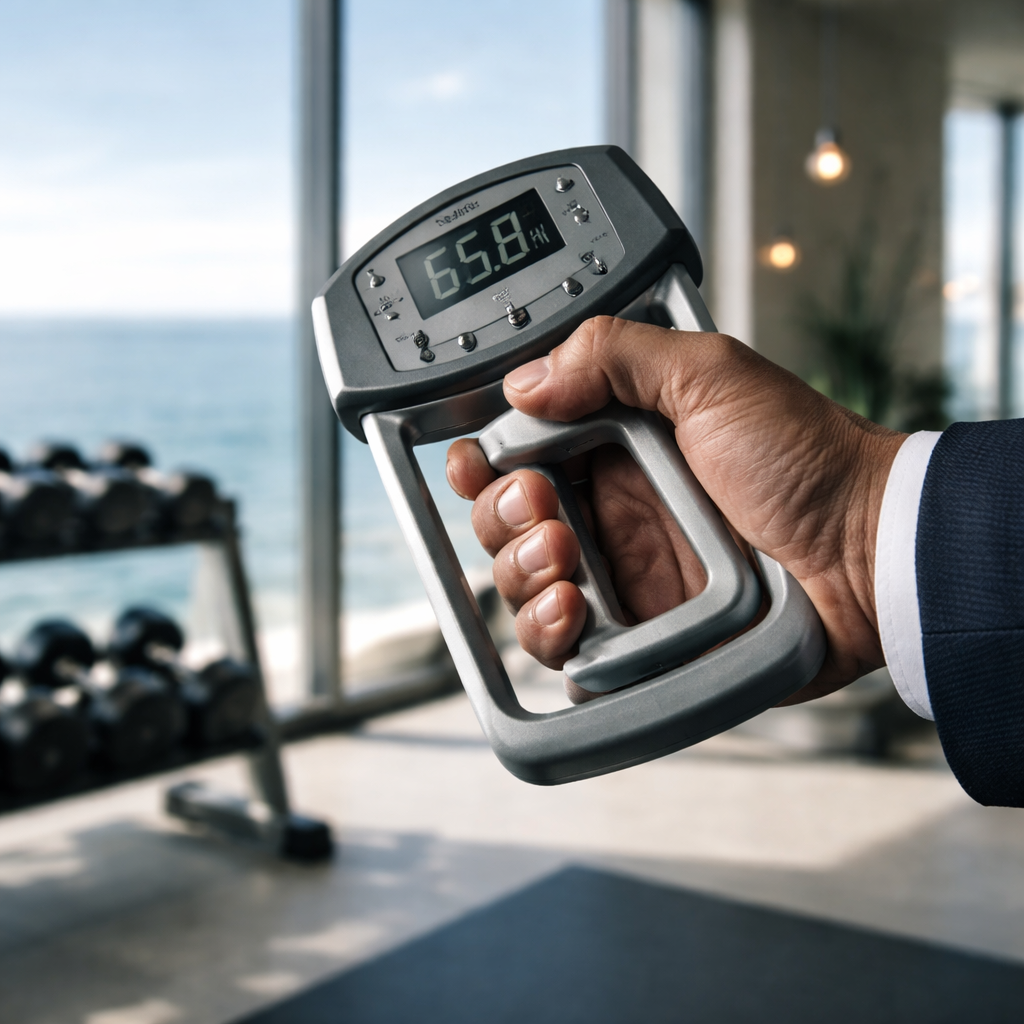
Illustration for conceptual purposes. Actual facilities and experiences at The Leela Vida may vary.
Grip strength is one of the most reliable indicators of long-term health, yet it remains widely overlooked. Most people focus on visible metrics such as weight, body fat, or appearance. These measures offer surface-level insight but fail to capture how the body performs. Grip strength provides a direct signal of function, resilience, and system-wide strength.
Executives track performance with precision in business. Revenue, output, and efficiency are monitored consistently. In health, the same discipline is rarely applied. The focus shifts toward aesthetics rather than capability. This creates a gap. Strength determines energy, stability, and long-term performance. Grip strength offers a simple way to measure it.
Grip strength reflects more than the hands. It correlates with total body strength, muscle mass, and nervous system efficiency. It shows how well the body can generate and sustain force under control. It also reflects coordination between brain and muscle.
When grip strength is strong, it usually indicates that multiple systems are functioning well together. When it declines, it often signals broader deterioration. This makes it a high-value metric for anyone focused on long-term performance.
The Research Behind Grip Strength
Large-scale studies confirm a clear pattern. Lower grip strength is linked to higher mortality risk. Stronger individuals tend to live longer and maintain independence. Decline in grip strength often appears before visible health issues.
In several studies, grip strength outperformed traditional metrics such as blood pressure and body mass index. This changes how health should be evaluated. It shifts focus from appearance to function.
Weight does not indicate capability. Two individuals with the same weight can perform at very different levels. One may move efficiently, maintain posture, and sustain energy. The other may struggle with fatigue and instability.
Strength supports movement, stability, and independence. When strength declines, the system becomes fragile. Injury risk increases. Recovery slows. Daily performance drops.
Grip strength provides a direct way to monitor this.
Strength is not only muscular. It is neurological. Grip strength reflects how effectively the nervous system activates muscle fibers. It measures coordination, control, and efficiency.
When grip strength declines, it often signals reduced neural activation. Reaction time slows. Control decreases. This affects both physical and cognitive performance.
For high-performing individuals, this has direct impact on decision-making, presence, and execution.
With age, muscle mass declines. Strength follows. This process is gradual and often unnoticed. Many individuals only recognize the impact once performance drops significantly.
Grip strength allows early detection. It provides a measurable signal before visible decline occurs. This creates an opportunity to act early and maintain performance over time.
Why Executives Should Track It
Executives operate under sustained demand. They require energy, presence, and resilience throughout the day. Strength supports all three.
Grip strength provides a simple, repeatable metric. It requires minimal equipment and time. Yet it delivers meaningful insight into overall condition.
For individuals who value control, this becomes a core measurement.
The Leela Vida Approach
Most environments focus on activity. Sessions are completed without structured measurement. Progress is assumed rather than tracked.
The Leela Vida gym in Barbados operates differently. Strength tracking, performance monitoring, and structured progression are integrated into the environment.
This reflects a broader shift in the market. High-income professionals now seek environments that integrate training, recovery, and productivity within one system.
Grip strength fits directly into this model. It provides a measurable input within a structured performance system.
Grip strength improves through resistance training. The most effective approach uses compound movements that engage multiple muscle groups.
Deadlifts, farmer carries, and pull-based exercises build grip strength alongside total body strength. These movements develop coordination, endurance, and stability.
Over time, this leads to stronger movement patterns and greater control under load.
Grip strength does not exist in isolation. It integrates with upper body strength, core stability, and posture. As grip improves, overall performance improves.
Training capacity increases. Heavier loads become manageable. Movement quality improves. Injury risk decreases.
This creates a compounding effect across all areas of training.
Strength development requires recovery. Without it, fatigue accumulates and performance declines. Injury risk increases.
Structured recovery supports consistent progress. It allows the body to adapt and maintain output over time.
An environment that integrates training and recovery creates long-term sustainability.
Practical Application
Grip strength should be measured consistently. Start with a baseline. Use a dynamometer or a controlled grip test. Record the result and track it over time.
Focus training on compound movements. Maintain consistency. Monitor trends rather than isolated results.
This creates awareness, progression, and control.
Strength affects more than physical performance. It influences posture, presence, and confidence. A stronger individual moves with greater control and certainty.
Grip strength is both visible and tangible. It reinforces discipline and consistency. Over time, this shapes how an individual carries themselves.
This has direct impact in professional environments.
Longevity Perspective
Longevity is not abstract. It is measurable. Grip strength provides a clear and actionable signal of long-term health.
It reflects system-wide condition. It responds to training and recovery. It offers feedback that can be acted upon.
For individuals focused on performance and longevity, this becomes a foundational metric.