
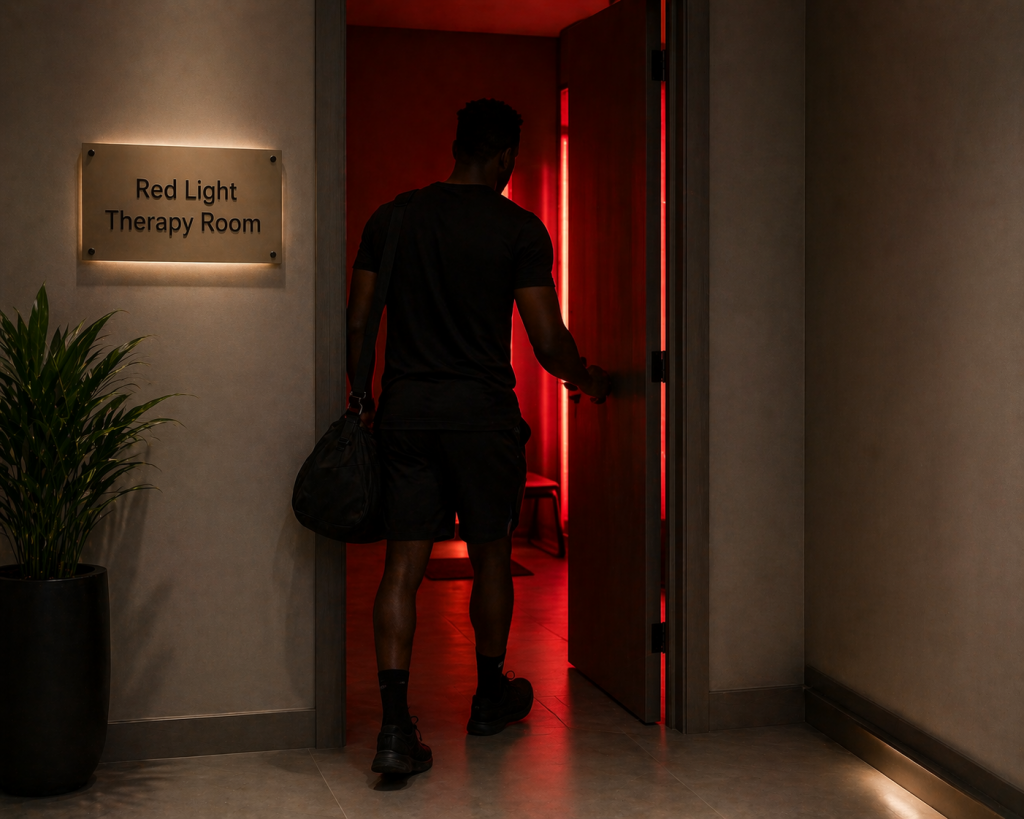
Illustration for conceptual purposes. Actual facilities and experiences at The Leela Vida may vary.
A red light therapy gym sounds modern enough to attract attention, but the real question is simpler: does it improve training quality and recovery, or does it just add another low-value layer to an already crowded routine?
For people who train with intent, the answer depends less on trend and more on context. Red light therapy may support recovery, circulation, skin health, and soreness management. That does not make it essential. It makes it useful in the right setting, with the right equipment, and within a routine that is already structured.
What a red light therapy gym actually offers
In practical terms, a red light therapy gym combines training facilities with access to red and near-infrared light devices. These systems are generally used before or after training, depending on the goal. Some people use them to prepare tissue and warm up lightly before movement. Others use them after sessions to support recovery and reduce perceived soreness.
The distinction matters because red light therapy is not training. It does not replace progressive overload, sound programming, sleep, nutrition, or mobility work. Its value is supportive, not primary.
That is where many public facilities get it wrong. They market red light therapy as if exposure itself is a performance strategy. It is not. It is one tool inside a larger system.
How red light therapy may support performance
The research around photobiomodulation is promising, but it should be read carefully. Benefits can vary based on wavelength, dose, treatment time, consistency, and the training status of the person using it.
Recovery and soreness
This is the most common reason people look for a red light therapy gym. Some evidence suggests red and near-infrared light may help reduce muscle soreness and support post-exercise recovery. For someone training several times per week, that can matter. Not because it creates dramatic changes overnight, but because small reductions in soreness can improve consistency.
Consistency is usually the deciding factor in long-term performance. If a recovery method helps you return to training with less friction, it has value.
Circulation and tissue support
Red light therapy is also used to support circulation and general tissue repair. Again, the benefit is usually incremental. Professionals with demanding schedules often do not need another intense intervention. They need tools that help maintain output without adding strain or consuming excessive time.
In that sense, red light therapy fits best when it is integrated into an existing training and recovery flow, not treated as a separate event.
Skin and general wellness
Some users are less interested in athletic recovery and more interested in skin quality or inflammation management. That can still be relevant inside a training environment, particularly for people who treat health as a full-system practice rather than a narrow gym objective.
Still, this is where expectations need control. A red light therapy gym should not promise cosmetic or medical outcomes beyond what the evidence reasonably supports.
What separates a useful red light therapy gym from a gimmick
Most of the difference comes down to equipment quality, operational design, and whether the environment respects routine.
If a facility offers red light therapy as a side feature with little guidance, limited privacy, or poorly maintained devices, the value drops quickly. The issue is not only the technology. It is the interruption. If recovery requires waiting in a noisy common area, adjusting around foot traffic, or fitting into an inconsistent schedule, many high-performing people stop using it.
A useful red light therapy gym removes that friction. The protocol is clear. The space is quiet. The equipment is credible. The timing works within the rest of the day.
That matters more than novelty.
Red light therapy gym use depends on your training style
Not everyone needs the same recovery structure. A person lifting three times a week with adequate sleep may notice only modest benefit. Someone training harder, balancing travel, or working under sustained cognitive demand may value even a small improvement in readiness.
If your schedule is dense
For executives, founders, and professionals with little margin in the day, recovery has to be efficient. A long recovery routine with multiple locations, appointments, or setup steps rarely lasts. In that case, a red light therapy gym is more appealing when it sits inside a single controlled environment where training, recovery, and work can happen without transition costs.
That is the real operational advantage. Not the device itself, but the removal of fragmentation.
If your recovery is already strong
If you sleep well, eat well, manage stress, and train with discipline, red light therapy may offer a marginal gain. That does not make it unnecessary. It simply places it where it belongs – as an enhancement rather than a correction.
People often overvalue new tools when the basics are weak and undervalue them when the basics are already strong. The truth sits in between. Red light therapy tends to work best for people who already have a stable routine and want to preserve it.
What to look for before joining a red light therapy gym
The first question is not whether red light therapy is available. It is whether the environment allows you to use it consistently.
Look at how the facility handles access, privacy, scheduling, and maintenance. If the equipment is technically present but difficult to use, the feature has little real value. Ask what kind of devices are used, how sessions are structured, and whether staff can explain appropriate timing and duration without resorting to vague claims.
It is also worth paying attention to what surrounds the therapy. In an overcrowded gym, recovery tools often become decorative amenities. In a controlled setting, they become part of a repeatable standard.
That distinction is often more important than the therapy itself.
Why environment matters as much as equipment
A calm training environment tends to improve adherence because it reduces decision fatigue. You are more likely to complete recovery work when the process is direct, private, and uninterrupted.
This is particularly relevant for professionals who do not separate physical performance from cognitive performance. If training leaves you depleted, and recovery is inconvenient, the rest of the day suffers. If recovery is built into the same environment, output is easier to protect.
That is one reason integrated performance spaces are more effective than public gyms with scattered add-ons. The issue is not luxury. It is operational coherence.
At The Leela Vida, that standard is understood in practical terms. Training, recovery, workspace, and nutrition are arranged to support a full day of performance without unnecessary transition or noise. In that kind of environment, red light therapy makes sense because it supports continuity rather than distracting from it.
Is a red light therapy gym worth it?
For some people, yes. For others, not yet.
If your current training routine lacks structure, a red light therapy gym will not solve the underlying problem. If your sleep, nutrition, and programming are inconsistent, the return will likely be limited. If, however, your routine is already disciplined and you want to reduce friction around recovery, it can be a worthwhile addition.
The best use case is not someone chasing novelty. It is someone protecting performance.
That is the filter worth using. Not whether red light therapy is popular, and not whether a gym advertises it prominently. Ask whether it fits the way you actually train, recover, and work. If it supports consistency, it earns its place. If it adds complexity, it does not.
A good performance environment does not collect features for effect. It selects tools that preserve routine, reduce noise, and keep output steady over time. Red light therapy belongs in that category only when it is used with the same discipline as training itself.
The more serious your schedule becomes, the less useful impressive amenities are on paper. What matters is whether the environment helps you keep doing the work well, repeatedly, and without disruption.