
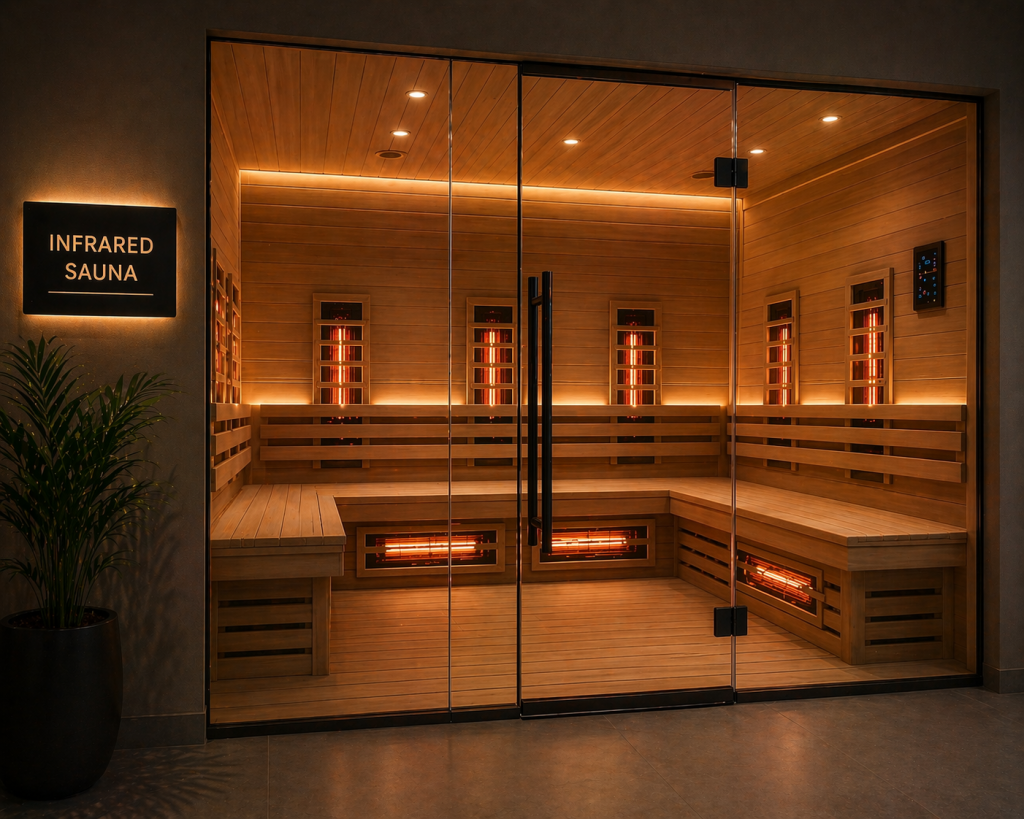
Illustration for conceptual purposes. Actual facilities and experiences at The Leela Vida may vary.
Recovery often fails for a simple reason: it is treated as optional until performance starts to slip. That is where an infrared sauna for recovery becomes useful. Not as a dramatic intervention, and not as a substitute for sleep, nutrition, or sound programming, but as a controlled tool that can help reduce friction in a demanding routine.
For professionals who train seriously while managing a full workday, the value is rarely about novelty. It is about whether a method fits into a repeatable schedule, supports physical readiness, and helps maintain clarity rather than disrupt it. Infrared sauna use can do that well, provided expectations stay precise.
Where infrared sauna for recovery fits
An infrared sauna heats the body more directly than a traditional sauna, which heats the air around you first. In practice, that usually means a lower ambient temperature with a different subjective feel. Some people tolerate it better for longer sessions. Others simply prefer it because it feels less oppressive after training.
The recovery case for infrared heat is fairly straightforward. Heat exposure may support circulation, promote relaxation, and reduce the sense of stiffness that often follows hard sessions. That can matter when training is not an isolated event but one part of a broader operating schedule that includes meetings, travel, and cognitive work.
Still, the phrase “for recovery” needs discipline. Recovery is not one thing. It includes muscular repair, nervous system regulation, hydration, sleep quality, and the ability to return to work or training with composure. An infrared sauna may help some of those dimensions more than others.
What it can realistically help with
The most immediate effect is often downregulation. After intense training, many people stay physiologically elevated longer than they realize. Heat, stillness, and a short period away from screens can create a useful transition. If the result is lower tension and better sleep later that evening, that matters.
There is also the question of perceived soreness and tightness. Not every athlete responds the same way, but many report that heat reduces the heaviness that can accumulate after strength work, conditioning blocks, or repetitive movement patterns. This does not necessarily mean tissue repair is dramatically accelerated. It means the body may feel more prepared for the next session, which has practical value.
Circulation is another reason infrared sauna use remains part of many recovery protocols. Increased blood flow can support the broader recovery environment, particularly when combined with hydration and adequate nutrient intake. That said, more circulation is not a cure-all. If programming is excessive, sleep is poor, or alcohol intake is high, sauna use will not correct the underlying problem.
Some also use infrared sessions to support mobility work. Heat can make soft tissue feel more pliable, which may improve the quality of light stretching or breathing work performed afterward. The benefit here is often modest but useful. Over time, modest gains done consistently tend to matter more than occasional extreme efforts.
The limits matter as much as the benefits
This is where most recovery content becomes imprecise. Infrared sauna is helpful, but it is not universally appropriate and it is not always the right choice immediately after training.
If you have finished a hard session in a hot climate, are already dehydrated, and still need to think clearly for the rest of the day, more heat may not be the best next step. The issue is not whether sauna is good or bad. The issue is timing. Recovery methods should reduce strain, not add another layer of it.
The same applies to frequency. Daily use can work well for some people, especially when sessions are short and hydration is managed carefully. For others, especially those in periods of high training load or travel fatigue, it may be better used selectively. More is not inherently better.
There are also individual health considerations. Anyone with cardiovascular concerns, blood pressure issues, heat sensitivity, or a medical condition that affects temperature regulation should be cautious and seek medical advice where needed. Precision is part of good recovery.
How to use an infrared sauna without turning it into another stressor
The best protocols are usually simpler than people expect. A moderate session, used consistently, is generally more productive than an aggressive one used irregularly.
For most people, 15 to 30 minutes is sufficient. Shorter sessions often work well after training, especially if the goal is to ease into recovery rather than test tolerance. If the body is still under high thermal strain from the workout itself, waiting until core temperature settles can be the more intelligent option.
Hydration should be handled before and after the session, not treated as an afterthought. If you finish a workout depleted and enter a sauna without replacing fluids, the session may leave you feeling flatter rather than better. Electrolytes can also be relevant, particularly in Barbados, where climate and training conditions can compound fluid loss quickly.
A useful structure is to pair sauna use with a quieter part of the day. For some, that means after training and before returning to work. For others, it fits better in the evening as part of a shutdown routine. The right choice depends on how your body responds to heat. Some people feel restored and focused afterward. Others feel too relaxed for demanding work. That distinction matters.
Infrared sauna and other recovery methods
No serious recovery practice relies on one tool. Infrared sauna works best inside a larger system.
Sleep remains the primary driver. If sleep duration and quality are unstable, sauna use may still feel good, but the larger recovery picture will stay limited. Nutrition follows closely behind. Protein intake, total calories, and meal timing all shape how well the body adapts to training stress.
Then there is movement. Light mobility work, walking, and lower-intensity sessions often do more for recovery than passive methods alone. Sauna can support that process, but it should not replace basic physical maintenance.
Cold exposure is often discussed alongside infrared heat, but they serve different purposes. Heat is generally more associated with relaxation and circulation. Cold is more often used for reducing acute soreness or creating a strong nervous system shift. Which is better depends on the person, the training phase, and the desired outcome. There is no value in forcing contrast methods into a routine if they create complexity without clear return.
Why environment changes the result
Recovery is not only about the method. It is also about the setting in which the method is used.
A crowded wellness space can undermine the very state recovery is meant to support. Noise, interruption, delays, and lack of privacy all create friction. For people who structure their day tightly, that friction is often why good intentions fail.
This is where a controlled environment has practical importance. If training, recovery, workspace, and nutrition exist in one system, compliance improves. You do not waste time transitioning across disconnected places. You do not lose focus between sessions. The recovery method becomes part of the day rather than an extra errand.
At The Leela Vida, that logic is straightforward. Recovery is not treated as an accessory to training. It sits within a private performance environment designed to protect routine, reduce distraction, and support consistent output. For the right person, that structure matters more than novelty ever will.
When infrared sauna is most useful
It tends to be most effective for people who already do the basics well and want to refine how they recover between sessions. If your sleep is respectable, your training is structured, and your schedule demands sustained output, infrared heat can be a sensible addition.
It is also useful for those who need recovery methods that are quiet and repeatable. There is little setup. There is no learning curve. And when used with restraint, it can become a stable part of a performance routine rather than another variable.
The key is to keep the role of the sauna proportional. Use it to support readiness, not to compensate for avoidable mistakes. If it helps you return to work calmer, train again with less stiffness, or maintain a more stable evening routine, it is doing enough.
A recovery tool does not need to be dramatic to be effective. It only needs to earn its place in the schedule.