
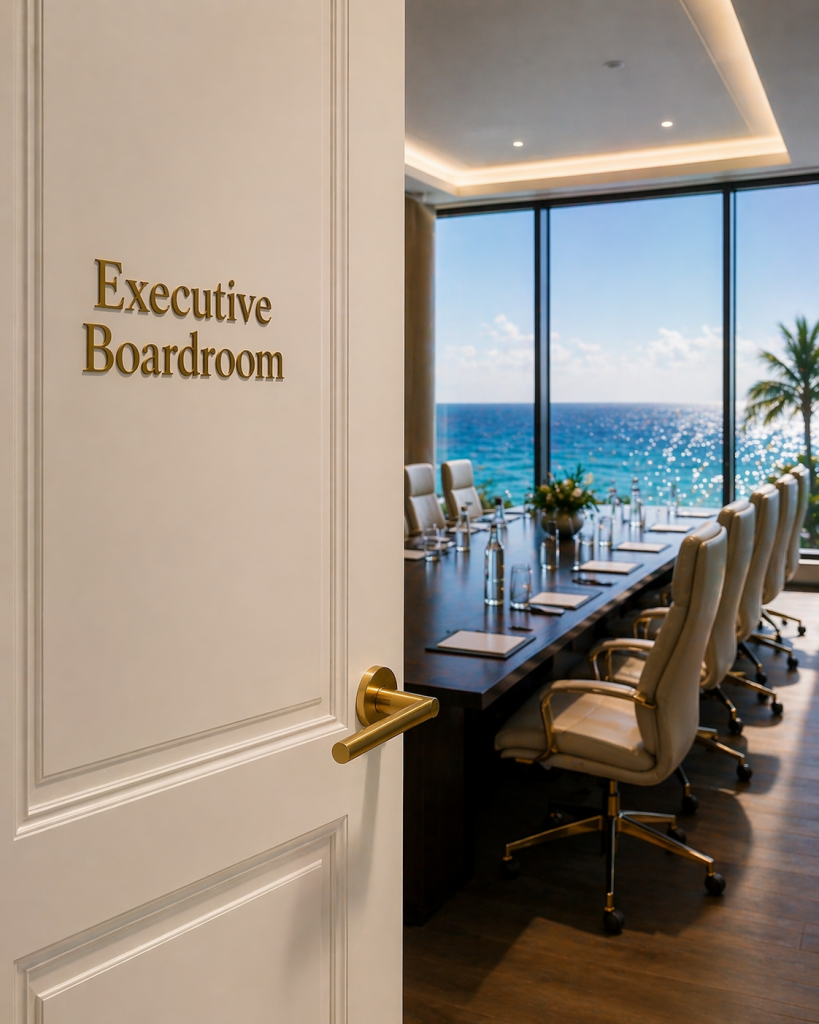
Illustration for conceptual purposes. Actual facilities and experiences at The Leela Vida may vary.
A board meeting that starts late because the room is still being reset, the screen does not connect, or outside noise keeps cutting through is not a minor inconvenience. It changes the quality of the discussion. When professionals search for boardroom rental Barbados options, they are usually not looking for square footage alone. They are looking for control.
That distinction matters. A boardroom is not simply a larger meeting room with better chairs. It is a working environment for decisions, sensitive conversations, investor updates, team reviews, and client meetings where pace, discretion, and clarity all affect the outcome. The right setting supports that standard quietly. The wrong one becomes part of the problem.
Why boardroom rental in Barbados requires more than a good address
Location still matters, but not in the superficial sense. A convenient address helps, particularly for executives moving between meetings, site visits, and airport schedules. What matters more is whether the space reduces friction once people arrive.
Many meeting rooms look acceptable in photos and underperform in use. They may be attached to busy hospitality venues, shared coworking floors, or public commercial spaces where movement, noise, and interruptions are difficult to control. For casual sessions, that may be manageable. For high-value meetings, it usually is not.
In Barbados, this becomes more relevant for local leaders, remote executives, and Welcome Stamp residents who run compressed schedules. If a meeting environment requires constant adaptation, it interrupts the day. A boardroom should do the opposite. It should hold the meeting in place so the people in it can focus on the work itself.
What actually defines a strong boardroom rental Barbados option
The most useful way to assess a boardroom is operationally. Not by style, and not by broad claims about premium service. A strong room supports the meeting before it starts, while it is in progress, and after it ends.
Privacy is the first filter
For board meetings, advisory sessions, hiring discussions, and financial reviews, privacy is not a bonus. It is the baseline. This includes acoustic privacy, controlled access, and a setting that does not expose attendees to unnecessary foot traffic.
Some venues offer attractive meeting spaces but place them beside café seating, open-plan work areas, or high-traffic reception zones. Even when the room itself is closed, the environment around it can compromise focus. If attendees feel observed, interrupted, or overheard, the room is not doing its job.
A better standard is simple: people enter, meet, and leave without disruption. The space should protect discretion without drawing attention to itself.
Layout affects the quality of discussion
A proper boardroom layout supports eye contact, clear lines of communication, note-taking, and screen visibility. That sounds obvious, but many rentals are fitted for general use rather than board-level discussion. The result is often a room that technically seats the right number of people but does not support the cadence of the meeting.
This becomes noticeable when attendees are spread too far apart, when the table shape weakens conversation, or when presentation screens are positioned for one side of the room instead of everyone. In a strategy session, those details are not cosmetic. They influence pace, participation, and decision-making.
The best approach is to match the room to the meeting format. A leadership review with six people has different requirements than a client presentation for twelve. A strong venue understands that capacity and usability are not the same thing.
Technology should be invisible
Meeting technology only gets noticed when it fails. Screen sharing should connect immediately. Video calls should be stable. Audio should be clear without forcing participants to raise their voices or repeat themselves.
This is one of the most common weaknesses in boardroom rentals. The room may appear well-equipped, but the setup often depends on improvised adapters, inconsistent Wi-Fi, or systems that require staff intervention every time they are used. That is wasted time at the exact moment professionals need momentum.
Reliable technology is rarely dramatic. It simply works without instruction, delay, or troubleshooting. For teams working across jurisdictions, or for executives splitting time between Barbados and overseas markets, this is non-negotiable.
The environment around the meeting matters
A boardroom does not operate in isolation. The surrounding environment shapes how people arrive, prepare, and reset between sessions.
This is where many boardroom rentals become fragmented. The room exists, but little around it supports a controlled day. There may be nowhere suitable for private calls before the meeting, no calm place to continue work afterward, and no access to well-prepared food that does not interrupt the schedule.
For professionals who structure their day carefully, that fragmentation is inefficient. A meeting should fit into the larger rhythm of performance, not break it apart.
At The Leela Vida, the workspace is part of a broader private environment built around focus, discipline, and continuity. That matters because serious meetings rarely stand alone. They sit inside a day that also includes training, recovery, concentrated work, and decisions that require a clear head.
When a hotel meeting room works – and when it does not
There are cases where a hotel boardroom is perfectly adequate. If the meeting is brief, low sensitivity, and driven mostly by convenience for visiting attendees, a well-run hotel can be practical. It may also make sense when event accommodation is the priority and the meeting room is secondary.
But there are trade-offs. Hotels are designed for volume and flow. Even strong properties have competing demands – guest movement, event turnover, food service traffic, and public activity. If discretion, calm, and environmental control are central to the meeting, a hospitality setting may be less suitable than a private workspace.
This is the difference between access and fit. A room can be available and still be wrong for the task.
Questions worth asking before you book
A boardroom rental should be screened with practical questions, not marketing language. Ask whether the room is in a private area or part of a shared public environment. Ask how many people it seats comfortably for the specific format you need, not just the maximum occupancy.
Confirm the screen setup, video call capability, Wi-Fi reliability, and whether someone has tested the room recently under normal operating conditions. Ask what happens if the meeting runs over, whether quiet workspace is available before or after, and how refreshments are handled without unnecessary interruption.
These questions are not excessive. They are efficient. They help reveal whether the venue understands professional use or simply rents rooms.
Why the best boardrooms support decision quality
The point of a boardroom is not appearance. It is decision quality.
That may sound strict, but it is the useful lens. If the room supports concentration, maintains privacy, minimizes friction, and keeps the meeting moving, it has value. If it introduces noise, delay, or environmental inconsistency, it reduces value regardless of the finishings.
For executives, founders, and senior operators, this is usually the real calculation behind boardroom rental Barbados searches. They are not trying to impress themselves with polished surfaces. They are trying to protect the standard of the conversation.
That is also why smaller, more controlled environments often outperform larger, more public venues. A room does not need to feel grand. It needs to feel settled. People should be able to think clearly in it, speak directly, and leave with decisions made.
Choosing the right space for the way you work
The right boardroom depends on the nature of the meeting and the standard of the people attending it. Some teams need convenience above all else. Others need discretion, environmental control, and a setting that fits into a disciplined workday without disruption.
If your meetings involve confidential discussion, remote participants, compressed schedules, or follow-on work that requires continued focus, the room should be selected accordingly. Not every meeting space is built for that. Many are simply adaptable enough to market themselves broadly.
A well-chosen boardroom removes variables. It gives structure to the hour, protects the discussion, and allows the rest of the day to continue cleanly. For most serious professionals, that is the requirement that matters.