
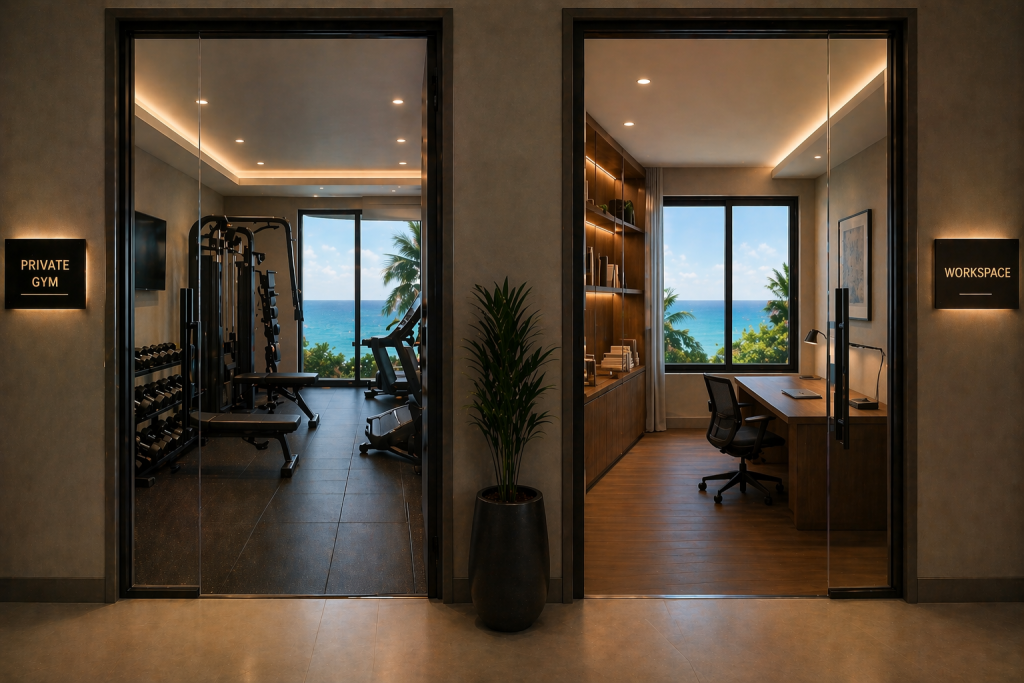
Illustration for conceptual purposes. Actual facilities and experiences at The Leela Vida may vary.
A fragmented day has a cost. Not just in time lost between locations, but in the mental resets required every time you move from a crowded gym to a café, from a call to a commute, from training to work without space to recover properly. A private gym with workspace solves a practical problem for professionals whose output depends on structure.
This is not about convenience in the casual sense. It is about preserving momentum. When fitness, recovery, work, and nutrition are handled in one environment, the day becomes easier to manage with precision. For founders, executives, and self-directed professionals, that difference compounds.
What a private gym with workspace actually provides
Most public gyms are designed around volume. Most coworking spaces are designed around occupancy. Neither is built around the needs of someone who wants to train seriously, think clearly, and work without interruption.
A private gym with workspace is different because it removes unnecessary transitions. Training is not separated from the rest of the day. It sits within it. You can complete a focused session, recover appropriately, sit down to work in a quiet environment, and continue without losing tempo.
That matters more than many people expect. Performance rarely breaks because of one major failure. It usually declines through smaller forms of friction – delays, noise, waiting, overstimulation, poor food choices, inconsistent recovery, and environments that require constant adaptation.
A properly structured environment reduces those variables.
Why high-performing professionals choose integrated environments
Professionals with demanding schedules tend to have the same constraint: limited attention. Time matters, but attention matters more. If an environment drains it, the rest of the day is compromised.
A private performance setting protects attention in a few specific ways. First, it reduces decision fatigue. You are not choosing between five locations or adjusting to different standards of cleanliness, equipment access, or noise. Second, it protects continuity. The shift from physical effort to cognitive work becomes intentional rather than abrupt. Third, it supports routine. And routine, more than intensity, is what produces durable results.
This is where the model becomes more than a gym added to office space. The value is not only that both functions exist. The value is that they are arranged to support one another.
If the gym is crowded, the benefit falls away. If the workspace is noisy, the structure breaks. If recovery is absent, training quality declines over time. If nutrition is an afterthought, energy becomes inconsistent by mid-afternoon. Integration only works when each part is held to a disciplined standard.
The operational advantage of one controlled setting
The strongest case for a private gym with workspace is operational.
Consider a common schedule. A professional trains in the morning at one facility, returns home to change, drives to an office or coworking space, leaves again for lunch, then tries to fit recovery into the evening if time permits. On paper, each activity is manageable. In practice, the transitions create drag.
A controlled environment consolidates that flow. Training can happen early, followed by recovery, then a direct move into focused work. Meals are handled without compromise. Meetings are taken in a space that reflects the same standard as the training floor. The day remains intact.
That structure is especially useful for people who do not separate wellbeing from work performance. Physical condition affects concentration, sleep, decision-making, and stress tolerance. The environment should reflect that reality rather than treating exercise as something done on the edges of an already crowded schedule.
Privacy is not a luxury feature
In a serious work and training environment, privacy is functional.
Public gyms create exposure. So do open coworking spaces. For some people that is irrelevant. For others, especially those managing teams, capital, clients, or public visibility, it is not. Constant social contact, background conversation, and familiar interruptions reduce the value of the space.
Privacy allows for consistency without performance becoming visible to others. You can train without waiting for equipment, work without being observed, and recover without distraction. That changes behavior. People tend to maintain better standards when the environment supports discipline rather than forcing them to defend it.
This is also why membership limits matter. Capacity shapes atmosphere. An overcrowded facility may still look refined, but it cannot remain calm. Once access outpaces control, the environment becomes reactive. Serious professionals notice that quickly.
Recovery is what makes the model complete
Many fitness and work concepts stop at access. They provide equipment and desks, then leave the rest to the individual. That is incomplete.
If the goal is sustained performance, recovery has to be part of the structure. Training creates demand. Work creates another. Without a deliberate recovery process, both begin to compete for the same finite reserves.
A private gym with workspace becomes far more effective when recovery is built in. That may include mobility work, cold exposure, compression systems, guided protocols, or assessment tools that help members understand how they are responding to training and workload. The exact method depends on the person. The principle does not.
Professionals who work at a high level usually do not need more stimulation. They need better regulation. Recovery supports that by improving readiness, preserving training quality, and preventing the gradual drop in clarity that often gets misread as overwork alone.
Nutrition cannot be treated separately
Food choices tend to deteriorate when the day is built around movement between locations. The nearest option becomes the default option.
That is one reason integrated environments matter. When nutritious food is available on site, the day holds its standard. Energy remains more stable. There is less need to improvise. The relationship between training, recovery, and cognitive work becomes easier to manage because intake is no longer random.
This does not require rigid meal plans or performative wellness culture. It requires food that is prepared well, available when needed, and aligned with the practical demands of the day.
For professionals who rely on consistent output, that is not a minor detail. It is part of the operating system.
Not every workspace-gym model is equal
The phrase private gym with workspace can describe very different environments. Some are essentially coworking spaces with a small fitness room attached. Others are luxury clubs designed more for social presence than measurable use. Neither necessarily supports disciplined routine.
The better question is whether the environment is built around performance or around appearance.
A credible setting should make it easy to move through the day without friction. Equipment should support serious training. Workspaces should be quiet, well-managed, and appropriate for concentrated thought. Recovery should be structured, not decorative. Nutrition should be practical. Capacity should be controlled.
It should also feel calm.
That point is easy to overlook, but it matters. Calm is not aesthetic. It is operational. Noise, crowding, and overstimulation pull attention outward. A composed environment protects it.
What this looks like in practice
For someone living or working in Barbados for an extended period, the ideal day is not defined by excess. It is defined by order.
You arrive early. Training is completed without waiting or interruption. Recovery follows while the body is still responsive. Work begins in an environment that is quiet enough to think clearly and private enough to handle serious conversations. Food is handled without leaving the standard of the day. By late afternoon, you are not trying to rebuild focus. You have maintained it.
That is the practical value of a place such as The Leela Vida. Not as a gym, and not as a coworking space, but as a private performance environment where the day can be structured properly.
For the right person, the appeal is immediate. For everyone else, it may seem unnecessary. That distinction is useful. A controlled setting is not meant to serve every preference. It is meant to protect a specific way of operating.
A good environment does not motivate you. It removes what interferes with discipline, then allows routine to do its work.