
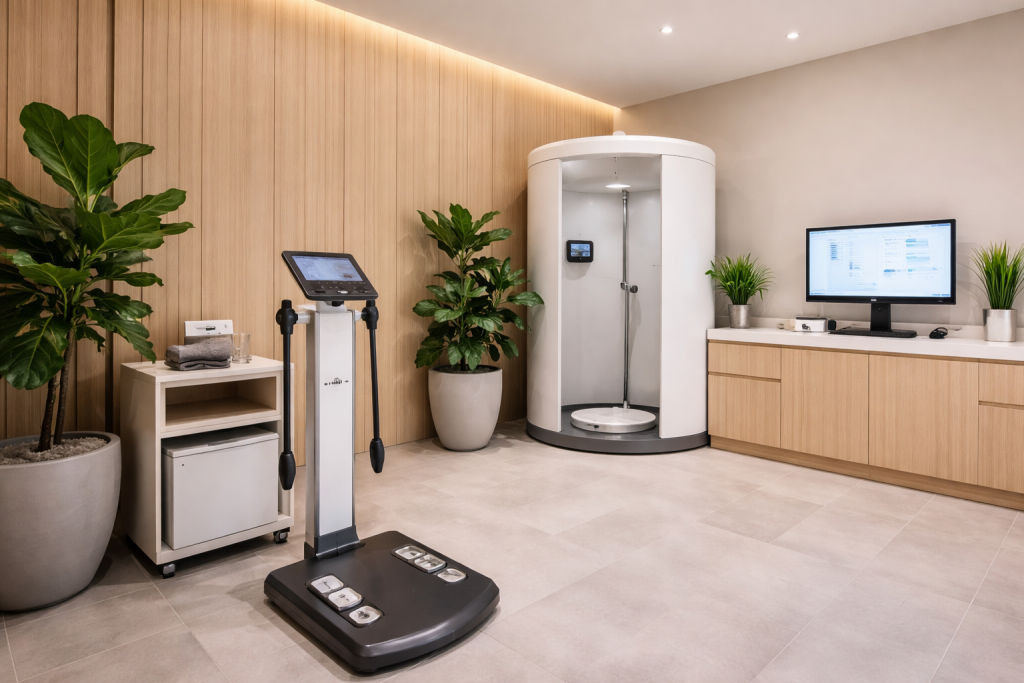
Digital illustration of the intended design and atmosphere. Final layouts and finishes may vary
Focus and Recovery Measured Require Data, Not Interpretation
Focus and recovery measured do not depend on how you feel on a given day. They depend on biological reality.
Two people can feel energized while one is overtrained. One can feel flat while adapting well. Stress hormones distort perception. Sleep debt accumulates quietly. Muscle loss hides behind stable body weight.
Without data, high performers guess. Guessing leads to overtraining, under recovery, and inconsistent results.
Measurement removes interpretation.
Why Feelings Fail High Performers
Feelings are reactive. They respond to short term stimuli. Caffeine. Music. Competition. Pressure.
Data reflects trends. Adaptation. Recovery capacity. Tissue quality. Lean mass stability.
High performers need trend visibility. Not emotional snapshots.
When focus declines, most professionals push harder. When recovery lags, they add supplements or motivation. These responses often worsen the issue.
Measurement changes behavior early.
What High Performers Actually Track
Elite systems track few metrics consistently.
Lean mass.
Fat mass.
Hydration trends.
Symmetry and balance.
Rate of change over time.
They do not chase daily fluctuations. They watch direction.
Focus improves when the mind trusts the data. Recovery improves when the body receives appropriate load.
Why Weight Alone Is Misleading
Body weight hides everything that matters.
You can lose weight and lose muscle.
You can maintain weight and lose recovery capacity.
You can gain weight through inflammation, not progress.
High performers who track weight alone misinterpret progress. This leads to unnecessary restriction or excessive training.
Objective body metrics remove this risk.
Focus and Recovery Measured Improve Decision Quality
When recovery declines, cognitive performance follows.
Reaction time slows.
Decision fatigue increases.
Emotional tolerance narrows.
Most professionals attribute this to work stress. In reality, physiological recovery often drives mental performance.
Measured recovery creates informed adjustments. Less guesswork. Fewer emotional decisions.
This stabilizes focus.
Why Consistency Beats Intensity
High performers often push in cycles. They train hard. Work intensely. Then crash.
Measurement favors consistency.
Small adjustments guided by data outperform extreme phases driven by motivation.
Recovery capacity improves when training aligns with physiology.
Focus improves when effort feels sustainable.
Objective Metrics Reduce Overtraining Risk
Overtraining rarely announces itself. It presents as irritability. Poor sleep. Flat performance.
Metrics detect changes before symptoms appear.
Lean mass drops signal insufficient recovery.
Hydration shifts indicate systemic stress.
Asymmetry flags compensation patterns.
Early detection protects performance longevity.
Why Visual Feedback Changes Behavior
Seeing data alters discipline.
When professionals see lean mass decline, they recover more intentionally. When they see stable progress, they resist unnecessary changes.
Focus sharpens because confidence increases.
Recovery improves because effort becomes precise.
This reduces mental noise.
The Role of Body Metrics in Aging Well
High performance is not limited to youth. Longevity depends on preserving lean tissue and recovery capacity.
Muscle loss accelerates after midlife. Without measurement, decline goes unnoticed until function drops.
Metrics provide accountability.
Recovery strategies evolve with age. Training adapts. Nutrition adjusts.
Focus remains sharp when the body remains resilient.
Why Guessing Fails at the Executive Level
Executives make hundreds of decisions daily. Fatigue compounds silently.
Without recovery tracking, decline feels normal.
Data breaks normalization.
It signals when recovery needs priority before performance slips.
This protects leadership quality.
Focus and Recovery Measured as a System
Measurement is not control. It is feedback.
The body responds to clarity.
When recovery aligns with output demands, performance stabilizes.
Focus improves because the system feels supported, not strained.
This is systems thinking applied to physiology.
How The Leela Vida Supports Focus and Recovery Measured
The Leela Vida integrates body metrics as a core performance tool.
A dedicated body metrics room provides objective measurement without distraction. No mirrors. No noise. No social pressure.
Members receive consistent tracking over time. Not one off scans. Trends matter.
This environment supports informed training, smarter recovery, and clearer decision making.
Measurements guide when to push and when to recover.
This removes guesswork.
Why Privacy Matters in Measurement
Measurement requires honesty. Privacy removes performance theater.
Without observers, data feels neutral. Members engage with metrics rationally.
This improves compliance and trust.
Focus improves when measurement feels safe.
Recovery improves when feedback is accurate.
Why Metrics Belong Near Work and Training
Separating measurement from daily routine reduces adherence.
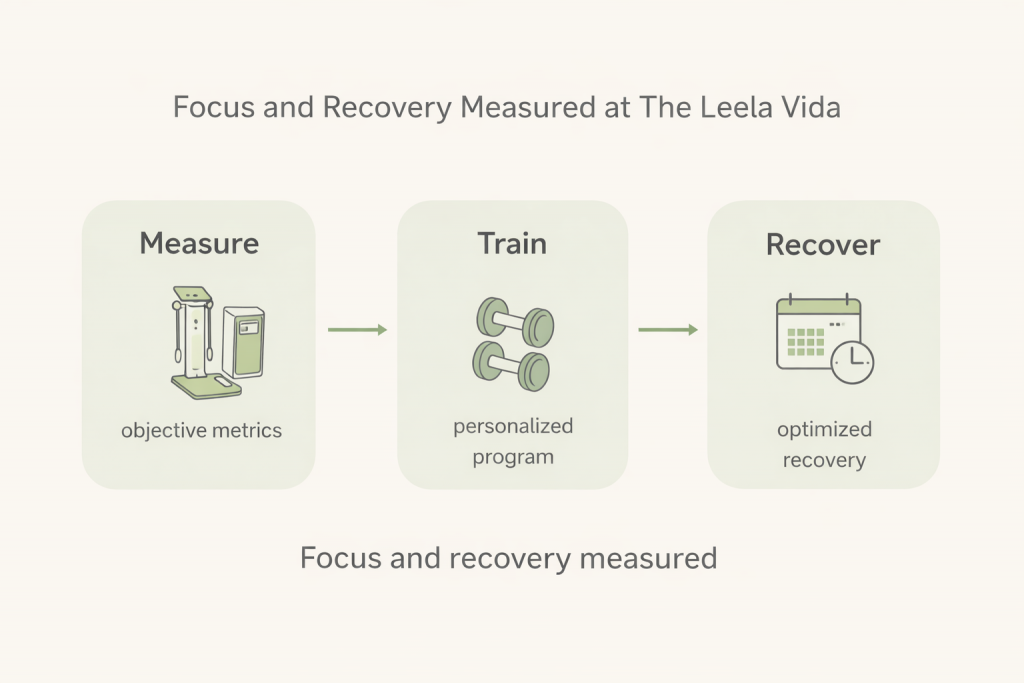
At The Leela Vida, body metrics sit within the performance ecosystem.
Work.
Train.
Measure.
Recover.
This flow reinforces consistency.
Time efficiency improves. Focus remains intact.
Recovery becomes intentional, not reactive.
Data Without Obsession
Metrics should inform, not dominate.
High performers succeed when data guides decisions quietly.
Weekly or monthly trends outperform daily fixation.
The Leela Vida positions metrics as a support tool, not an identity.
This prevents anxiety and promotes clarity.
Why Objective Progress Sustains Motivation
Motivation fluctuates. Data endures.
When progress becomes visible, effort feels justified.
Recovery feels purposeful.
Focus stabilizes because direction is clear.
This creates long term adherence.
Focus and Recovery Measured Protect Against Plateaus
Plateaus often reflect recovery mismatch, not effort failure.
Metrics reveal whether output exceeds capacity.
Adjustments restore progress without frustration.
Focus returns when results respond.
Recovery improves when load matches physiology.
Why This Matters More Than Ever
Modern professionals face constant stimulation. Recovery becomes fragmented.
Without measurement, decline hides behind productivity.
Objective metrics reveal the truth early.
This protects careers, health, and performance.
Focus and recovery measured are no longer optional for high performers.
They are foundational.
Closing Perspective
High performers do not rely on feelings. They rely on systems.
Measurement replaces guessing.
Recovery replaces grinding.
Focus replaces effort.
The Leela Vida supports this shift through intentional design, objective tracking, and performance centered environments.
This is how sustainable excellence is built.
- Digital illustration of the intended design and atmosphere. Final layouts and finishes may vary
Sources:
- National Institutes of Health. Skeletal Muscle and Aging
- https://www.ncbi.nlm.nih.gov/pmc/articles/PMC2804956/
- Cleveland Clinic. Recovery and Nervous System Balance
- https://my.clevelandclinic.org/health/articles/21202-nervous-system
What does focus and recovery measured mean?
Focus and recovery measured refers to using objective body metrics to guide training, recovery, and performance decisions instead of relying on feeling alone.
Why are body metrics important for high performers?
Body metrics show real trends in muscle, fat, and recovery capacity, which helps high performers adjust effort before performance declines.
How does measuring recovery improve focus?
When recovery is measured, training and work align with physiological capacity, which stabilizes attention and decision quality.
How does The Leela Vida support focus and recovery measured?
The Leela Vida provides a private body metrics room that allows members to track progress objectively and adjust training and recovery with clarity.
How often should body metrics be reviewed?
Most high performers benefit from periodic tracking over time, focusing on trends rather than daily fluctuations.