
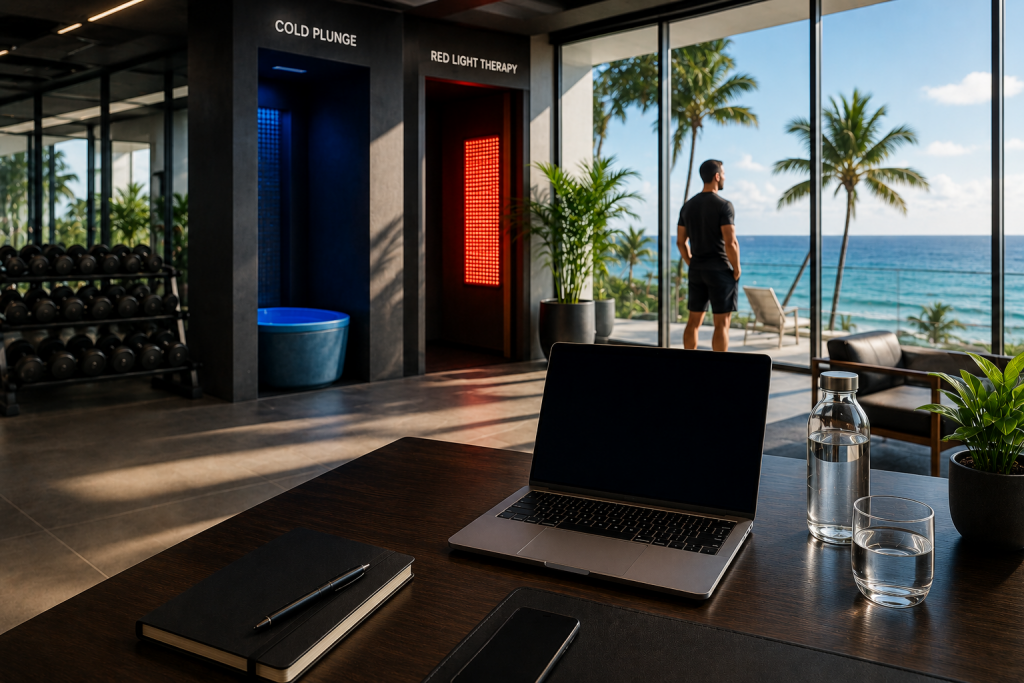
Illustration for conceptual purposes. Actual facilities and experiences at The Leela Vida may vary.
A professional can now spend an entire day moving between meetings, messages, decisions, and travel without ever entering a setting built to support physical or cognitive performance. That mismatch is why future of work wellness integration is no longer a lifestyle topic. It is an operational one.
For high-performing professionals, work is not separated neatly from the body that carries it. Sleep quality affects judgment. Training affects energy regulation. Recovery affects output the next day. Nutrition affects focus within hours, not weeks. Yet most work environments are still designed as if performance begins and ends at a desk.
That model is losing relevance.
What future of work wellness integration actually means
In practical terms, future of work wellness integration means building a workday where training, recovery, nutrition, and focused work are structured together rather than treated as separate categories. It is not a matter of offering a meditation app, occasional yoga class, or a refrigerator stocked with branded drinks. Those are amenities. Integration is different.
Integration changes the sequence of the day. It allows a person to train before work without adding a second commute. It makes recovery available before fatigue becomes cumulative. It removes the gap between healthy intent and actual execution. Most of all, it reduces friction.
For disciplined professionals, friction is often the real problem. The issue is rarely a lack of awareness. It is the cost of switching environments, losing time in transit, and rebuilding concentration after each interruption. When work, physical maintenance, and recovery are fragmented across different places, consistency becomes harder than it should be.
Why the future of work wellness integration is becoming structural
The old office model was built around visibility and fixed hours. The current work model is built around output, responsiveness, and sustained decision-making. That shift changes what people need from the environment around them.
If work is more flexible but more mentally demanding, then the supporting environment matters more, not less. Professionals are expected to perform with range – strategic thinking, fast communication, emotional control, and long attention spans – often within the same day. That level of output cannot be treated as purely intellectual. It has a physical basis.
This is where many workplaces still fall short. They recognize burnout after it appears. They address stress once it starts affecting retention. They discuss wellness as culture rather than infrastructure. That approach is reactive.
A more serious standard treats wellness as part of the operating system. Not soft. Not decorative. Simply necessary.
There is a trade-off, of course. Full integration requires intentional design, higher standards, and in many cases a narrower audience. It does not suit every business or every worker. A large company managing thousands of employees will solve this differently from a private environment serving founders, executives, and professionals who structure their day around performance. But the direction is clear. The closer wellness moves to the flow of work, the more likely it is to be used consistently.
The difference between benefits and environment
A great deal of workplace wellness still lives in the language of benefits. Stipends, classes, partnerships, and occasional programming all have value, but they depend on separate effort. They ask people to leave the structure of the day, then return to it.
Environment works differently. It shapes behavior without constant negotiation.
A controlled setting makes certain actions easier to repeat. Focus improves when noise is limited. Training becomes routine when it is part of the same location as work. Recovery becomes normal when it is available without logistical friction. Nutrition improves when quality food is present at the point of need rather than delayed until the day is already off track.
This distinction matters because high performers do not usually fail from lack of intention. They fail from accumulated disruption. An environment that protects routine will outperform a long list of optional wellness offerings almost every time.
What integrated wellness looks like in practice
The practical version is less glamorous than most marketing suggests. It is a day that holds its shape.
A professional arrives early, trains with purpose, and transitions to work without losing momentum. Between work blocks, recovery is not an indulgence but a way to maintain physical and mental steadiness. Meals support clarity rather than create an afternoon decline. Workspaces are quiet enough for concentration and private enough for serious conversations. The day is not split into competing identities – worker, athlete, commuter, patient, diner. It is one continuous operating rhythm.
That continuity is what many professionals have been trying to build privately for years. They optimize schedules, stack appointments, and try to protect windows for training and recovery. The issue is not willingness. The issue is fragmentation.
In Barbados, this is particularly relevant for executives, founders, and Welcome Stamp residents who work internationally while maintaining local routines. When work can happen from anywhere, the quality of the environment becomes a deciding factor. Convenience alone is not enough. The space has to support concentration, privacy, and repeatable standards across the full day.
Why privacy and calm matter more than scale
Many discussions about workplace wellness focus on access. More access, more options, more activity. That logic suits mass-market spaces. It does not always suit serious performance.
For professionals managing high-value decisions, privacy is not a preference. It is part of how they work. Overcrowded gyms, social coworking spaces, and public recovery settings introduce noise, delay, and unpredictability. Even when the facilities are well designed, the atmosphere can still work against consistency.
Calm environments tend to be underestimated because they appear simple. In practice, calm requires control. It requires limits, standards, and a level of restraint that many commercial spaces do not maintain. Fewer people, clearer expectations, and less ambient disruption often produce better work and better training than environments built for volume.
This is one reason the future of work wellness integration will not look the same everywhere. Some models will aim for broad accessibility. Others will be intentionally selective. For a certain type of professional, a capped and disciplined environment is not exclusive branding. It is a functional requirement.
The role of measurement without obsession
Integration also changes how progress is evaluated. In a fragmented routine, people tend to rely on subjective impressions. They feel tired, productive, distracted, or strong, but the pattern is hard to interpret because too many variables are moving at once.
A structured environment allows better measurement. Body metrics, performance assessments, recovery markers, and work patterns can be observed in context. That does not mean reducing health to dashboards. It means using data to support consistency rather than replacing judgment.
There is a balance here. Too little measurement leads to guesswork. Too much measurement creates noise and self-interruption. The goal is not constant monitoring. The goal is enough feedback to make useful adjustments and maintain long-term stability.
Where this model is heading
The next phase of work will likely place less value on office presence and more value on repeatable output. As that happens, the environments that stand out will be those that support a full performance cycle rather than a narrow work function.
That does not mean every office becomes a training facility or every professional wants a fully integrated setting. It means the market is becoming clearer. Some people want convenience and social energy. Others want structure, privacy, and sustained performance. Those are different categories, and they should not be confused.
The stronger model for serious professionals is the one that reduces decisions, protects focus, and supports the body with the same care given to work itself. That is where wellness stops being an extra layer and becomes part of the standard.
The Leela Vida reflects this shift with unusual precision. Not by adding wellness to work, but by placing work, training, recovery, and nutrition inside one controlled environment where routine can hold.
The future will favor environments that ask less of your attention and give more back to your discipline.
FAQ
What is wellness integration in the workplace?
Wellness integration combines training, recovery, nutrition, and focused work into one environment, helping professionals maintain performance, energy, and productivity throughout the day.
Why are professionals seeking integrated wellness environments?
Many professionals want to reduce time spent commuting between gyms, offices, and recovery facilities. Integrated environments make it easier to maintain healthy routines consistently
How does wellness affect work performance?
Physical health, sleep quality, recovery, and nutrition all influence focus, decision-making, energy levels, and overall productivity during the workday.
What facilities support work and wellness integration?
Modern integrated environments often include fitness facilities, private workspaces, recovery therapies, healthy dining options, and performance tracking tools designed to support both physical and professional performance.
Who benefits most from integrated wellness environments?
Executives, entrepreneurs, remote workers, Welcome Stamp residents, and professionals with demanding schedules often benefit most because they value efficiency, privacy, and a structured daily routine.