
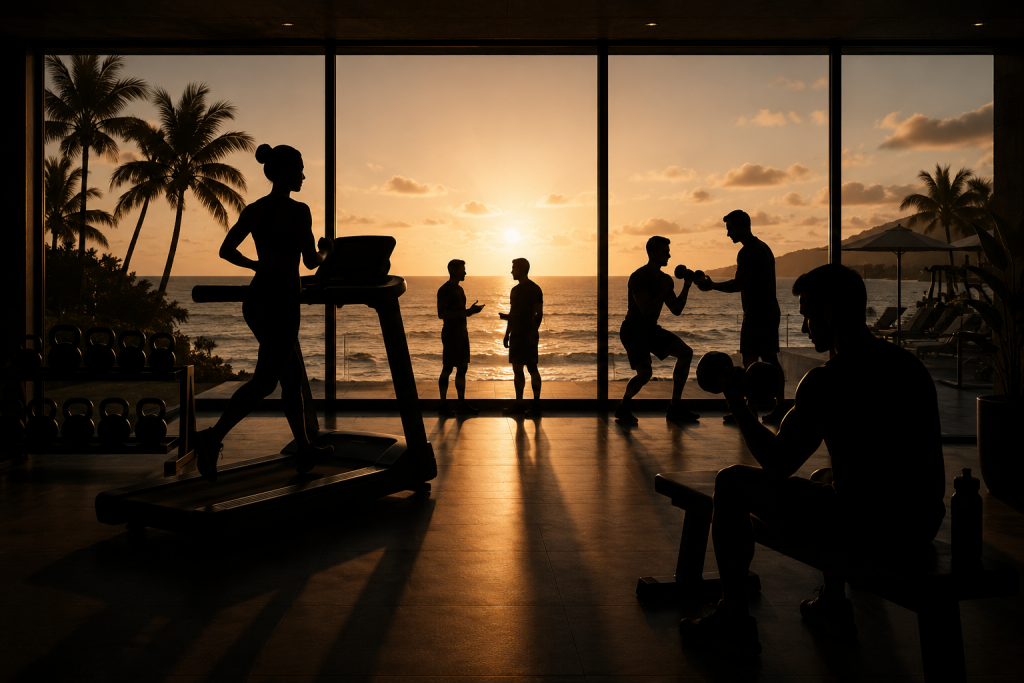
Illustration for conceptual purposes. Actual facilities and experiences at The Leela Vida may vary.
At 7:00 a.m., the difference is usually obvious. In one setting, every rack is taken, the floor is noisy, and half the session is spent adjusting to other people’s pace. In a limited membership fitness club, the environment holds. Equipment is available. Movement is uninterrupted. The quality of the hour remains intact.
That distinction matters more than most operators admit. For professionals who train with intent, the issue is not access alone. It is the ability to maintain a standard. If training, recovery, work, and nutrition are meant to support output, then the environment cannot be treated as incidental. It has to be controlled.
What a limited membership fitness club actually changes
A membership cap is often misunderstood as positioning. In practice, it is operational. It determines how many people move through the space, how long they wait, how much noise accumulates, and how often routines are forced to adapt. When numbers are unrestricted, crowding becomes part of the model. Members are then expected to tolerate variability as normal.
A limited membership fitness club works differently. The cap protects the experience by protecting the schedule. Sessions begin on time, equipment remains accessible, and recovery areas do not become overflow space. The result is not exclusivity for its own sake. It is a setting where consistency can survive contact with the day.
This is especially relevant for people whose calendar is already compressed. If a founder, executive, or remote professional has a ninety-minute window for training, transition, and the first work block, there is little room for friction. A delayed set, an overcrowded locker room, or a noisy workspace is not a minor inconvenience. It weakens the entire sequence.
Why crowding undermines performance
Most public facilities are built around volume. That model can work for general access, but it rarely serves disciplined routine. High traffic changes behavior. People shorten sessions, skip parts of their program, avoid peak hours when possible, and tolerate an environment that slowly lowers the standard of training.
The effects are cumulative. Strength work becomes less precise when rest periods are dictated by equipment availability. Recovery becomes inconsistent when cold plunge, compression, or mobility space is in constant demand. Nutrition decisions drift when the next stop is off-site and dictated by convenience rather than plan.
None of this is dramatic in isolation. Over weeks and months, it becomes structural. Progress is not usually lost in one poor session. It is lost through repeated disruption that seems small enough to excuse.
A controlled environment removes much of that background noise. Not every member needs the same program, but they do need the same condition: the ability to carry out a program without avoidable interruption.
The real value is continuity
People often discuss fitness environments in terms of amenities. That framing misses the point. The useful question is whether the environment allows one action to move cleanly into the next.
Training is only one part of performance. The session itself matters, but so does what follows it. Recovery should be immediate rather than postponed. Work should begin without a commute between mental states. Food should support output rather than solve hunger at the nearest available option. When these functions are split across several locations, the day becomes fragmented.
A well-run limited membership fitness club reduces that fragmentation. The member trains, recovers, checks metrics or assessment data when needed, moves into focused work, and eats without stepping outside the structure of the day. This does not make discipline unnecessary. It makes discipline easier to sustain.
That distinction matters. High-performing people do not usually struggle because they lack motivation. They struggle because too many decisions are left exposed to friction. The more essential routines can be contained in one environment, the more likely they are to remain consistent under pressure.
Limited access supports privacy as much as convenience
For some members, privacy is not a preference. It is part of how they work. Public gyms and open coworking spaces ask for a level of social tolerance that does not suit everyone, especially individuals whose days already involve meetings, demands, and visibility.
A capped membership protects more than floor space. It protects discretion. Members are not moving through a revolving door of drop-ins, day passes, and casual traffic. The environment remains stable. Familiarity replaces exposure. That changes how people use the space.
They train with greater concentration. They recover without feeling observed. They work without the low-grade noise that comes from transient, public settings. For someone managing a business, a team, or a high cognitive workload, this kind of calm is not decorative. It preserves energy.
When the model works best
A limited membership fitness club is not for everyone. If someone values variety above routine, enjoys high-energy public settings, or uses fitness casually, the structure may feel unnecessary. The model works best for people who already know how they want to move through the day.
That usually includes professionals with fixed training habits, individuals managing demanding work from a laptop or phone, and people who care about measurable output rather than recreational access. They do not need spectacle. They need reliability.
This is one reason integrated private environments have gained relevance in places like Barbados, where many residents and long-stay professionals are balancing work, health, and time with unusual precision. If the island is home for a season or for the long term, routine still matters. In some cases, it matters more, because external structure is lighter and self-management carries more of the load.
What to look for beyond the membership cap
A cap alone does not guarantee quality. It only creates the possibility of control. The real question is how the space is designed and managed.
The first issue is flow. A serious environment should allow a member to move from training to recovery to work without friction or unnecessary handoff. If each function feels isolated, the advantage is reduced.
The second is standards. Equipment, recovery systems, cleanliness, and scheduling all need to remain consistent over time. A quiet room that becomes noisy by midday is not well controlled. A recovery suite that regularly requires waiting is not functioning as intended.
The third is member fit. In a capped environment, the behavior of the membership base matters as much as the physical layout. Shared discipline creates much of the calm people are actually paying for. If the club accepts everyone, the cap becomes less meaningful.
This is where some private performance environments distinguish themselves. The strongest ones are not trying to accommodate every use case. They are built for a narrow set of needs and maintain that standard without apology. The Leela Vida follows this logic by treating training, recovery, workspace, and nutrition as one operating system rather than separate conveniences.
The trade-off is selectivity
There is a practical trade-off to this model. A limited membership fitness club is necessarily less available than a mass-access facility. It may involve screening, waiting, or a level of commitment that casual users do not want. For the right member, that is not a drawback. It is part of the function.
The point is not to restrict for effect. The point is to preserve conditions that disappear once volume becomes the priority. That means the environment may feel exacting. Expectations may be clearer. The space may ask members to value structure as much as they value access.
That will not suit everyone, and it should not try to.
Why this model continues to matter
As work becomes more mobile and schedules become less fixed, people often assume flexibility is the goal. In reality, many high-performing professionals need the opposite. They need environments that reduce unnecessary choice, protect attention, and support repeatable behavior.
That is what a limited membership fitness club can provide when it is well executed. Not novelty. Not noise. Not the appearance of luxury. A controlled setting where training happens properly, recovery is built in, work remains focused, and the day does not fragment before noon.
For people who take performance seriously, that is usually enough. And often, it is the difference between a routine that survives pressure and one that slowly disappears under it.
FAQ
What is a private fitness club?
A private fitness club limits membership to maintain a quieter, more personalized environment. Members benefit from greater privacy, reduced crowding, and higher service standards than typically found in public gyms.
Why do professionals prefer private fitness clubs?
Professionals often value efficiency, privacy, and consistency. A private fitness club allows them to train, recover, and focus without the distractions and congestion common in larger public facilities.
Are private fitness clubs worth the higher membership fee?
For many members, the value comes from time savings, improved access to facilities, enhanced privacy, premium amenities, and a more focused environment that supports long-term wellness goals.
What are the benefits of limited membership?
Limited membership helps reduce wait times, preserve facility quality, improve service levels, and create a stronger sense of community among members who share similar values and lifestyles.
Who is best suited to a private fitness club?
Private fitness clubs are often ideal for executives, entrepreneurs, remote professionals, expatriates, and individuals who prioritize wellness, privacy, recovery, and a high-quality training environment.