
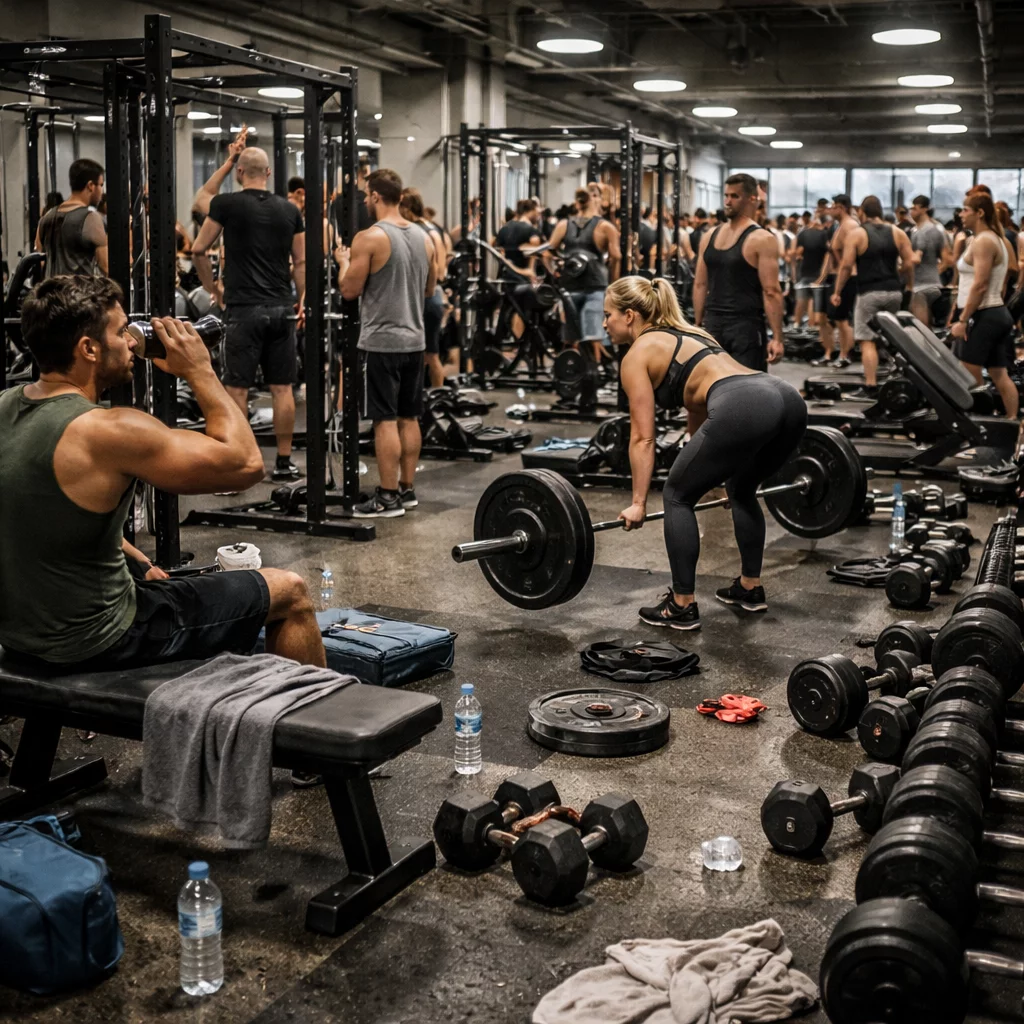
Illustration for conceptual purposes. Actual facilities and experiences at The Leela Vida may vary.
The Environment Mismatch
High-performing professionals operate in structured, controlled environments where time, output, and decision quality are tightly managed. Public gyms do not reflect this standard. They are built for access, not performance. They serve high volume, mixed intent users, and unpredictable usage patterns. This creates a structural mismatch between the expectations of disciplined professionals and the reality of the environment. When you enter a space that lacks order, control, and intentional design, your performance adjusts downward. You are no longer executing a defined system. You are reacting to conditions. This is the first failure point. A performance environment must mirror the way you operate in business. It must remove variability and protect your routine. Without this alignment, consistency breaks and results decline.
Time Inefficiency Compounds Daily
Time loss in public gyms is not obvious in a single session, but it compounds over weeks and months. Waiting for equipment, adjusting exercises due to availability, navigating crowded spaces, and dealing with interruptions all reduce session efficiency. If you lose 15 minutes per session and train five times per week, you lose over six hours per month. That is a full working day of lost output. For a high-performing professional, this is unacceptable in any other domain. Yet it is tolerated in training. This inefficiency reduces intensity and often leads to shortened sessions or skipped recovery work. Over time, this affects results. A controlled environment removes waiting and compresses sessions into precise, uninterrupted blocks. This restores time efficiency and aligns training with a high-performance schedule.
Loss of Execution and Training Integrity
In a public gym, you rarely execute your training plan exactly as intended. Equipment is occupied, space is limited, and you are forced to modify exercises or change sequencing. This creates inconsistency in stimulus, which directly affects results. You begin to compromise without realizing it. Sets are skipped. Load progression slows. Focus shifts. Over time, this leads to stagnation. High-performing professionals rely on systems that produce predictable outputs. In training, this requires the ability to execute the same structured plan repeatedly without interference. When the environment prevents this, performance becomes variable. A private, controlled setting ensures full execution. Every session follows the intended structure. This is how measurable progress is sustained.
Cognitive Load and Mental Distraction
Public gyms increase cognitive load. You are required to make constant micro-decisions throughout your session. Which equipment is free. What exercise to replace. How to adjust your timing. How to navigate other members. This creates decision fatigue before your workday has even begun. High-performing professionals already operate under significant cognitive demand. Adding unnecessary mental load reduces clarity and focus. It also reduces training intensity because attention is fragmented. A high-performance environment minimizes decision-making. The structure is clear. The flow is predictable. The space is calm. This allows you to enter a focused state where training becomes deliberate and efficient. Removing cognitive friction is not a luxury. It is a requirement for sustained performance.
Lack of Privacy and Control
Privacy is a key requirement for many professionals, particularly those operating at senior levels. Public gyms do not offer this. They are open environments with constant movement, observation, and interaction. This limits your ability to train with full focus. It also introduces discomfort for individuals who value discretion. Beyond privacy, there is a broader issue of control. You cannot control who is in the space, how equipment is used, or the general behavior of others. This unpredictability reduces the quality of the environment. High performers seek spaces where standards are maintained and behavior aligns with shared expectations. A private club environment enforces this alignment. It creates a space where members operate with discipline, respect, and intention. This directly supports performance and consistency.
Absence of Integrated Recovery
Public gyms are built around equipment. They do not integrate recovery into the training system. This creates an incomplete model. Recovery is essential for maintaining output, reducing fatigue, and supporting long-term progression. Without it, performance declines over time. High-performing professionals require systems that support both exertion and recovery within the same environment. This includes structured access to cold exposure, heat therapy, and other recovery modalities. When recovery is separate, it is often skipped due to time constraints. When it is integrated, it becomes part of the routine. This improves adherence and results. A complete system does not end with training. It includes the full cycle of stress and recovery.
Inconsistency and Broken Momentum
Consistency drives results. Public gyms make consistency difficult. Peak hour congestion, variable conditions, and unpredictable session quality create friction. This leads to missed sessions or reduced intensity. Momentum breaks. Once consistency is lost, progress slows. High-performing professionals rely on routines that are repeatable and stable. Training should follow the same principle. A controlled environment ensures that each session is delivered under the same conditions. This allows habits to form and performance to compound. Consistency becomes automatic rather than forced. Over time, this is the difference between average results and sustained improvement.
The Shift Toward Private Performance Environments
There is a clear shift among high-income professionals away from public gyms toward private, controlled environments. This shift is driven by logic rather than preference. Professionals are seeking spaces that align with their standards of efficiency, privacy, and performance. They value environments that reduce cognitive load, protect time, and integrate multiple functions into one system. The traditional gym model does not meet these needs. It remains focused on access and volume. Private clubs operate differently. They are designed around outcomes. They limit membership, control the environment, and integrate training, recovery, and workspace into a single system. This reflects a broader trend toward environments that support both physical and cognitive performance.
What High-Performing Professionals Require
High-performing professionals do not need more options. They need fewer, better ones. They require an environment that removes friction and supports execution. This includes immediate access to equipment, structured training flow, integrated recovery, and a calm, focused atmosphere. It also includes a peer group that shares similar standards and behaviors. When these elements are present, adherence improves and results follow. Training becomes efficient and repeatable. Time is protected. Focus is maintained. The environment supports performance rather than undermining it. This is the standard that professionals expect in every area of life. Training should be no different.
The Leela Vida Standard
The Leela Vida is designed as a controlled performance environment rather than a public facility. Membership is limited to protect space, privacy, and consistency. Every element of the environment is structured to reduce friction and support output. There is no overcrowding, no waiting, and no disruption to training flow. Recovery is integrated into the system, allowing members to complete the full cycle of performance in one location. The atmosphere is calm, disciplined, and aligned with the expectations of high-performing professionals. This is not a traditional gym model. It is a performance system. It reflects the way executives, founders, and senior professionals operate in their work. It provides an environment where training, recovery, and focus are protected. This is why the model exists and why it continues to gain traction among those who value performance over access.