
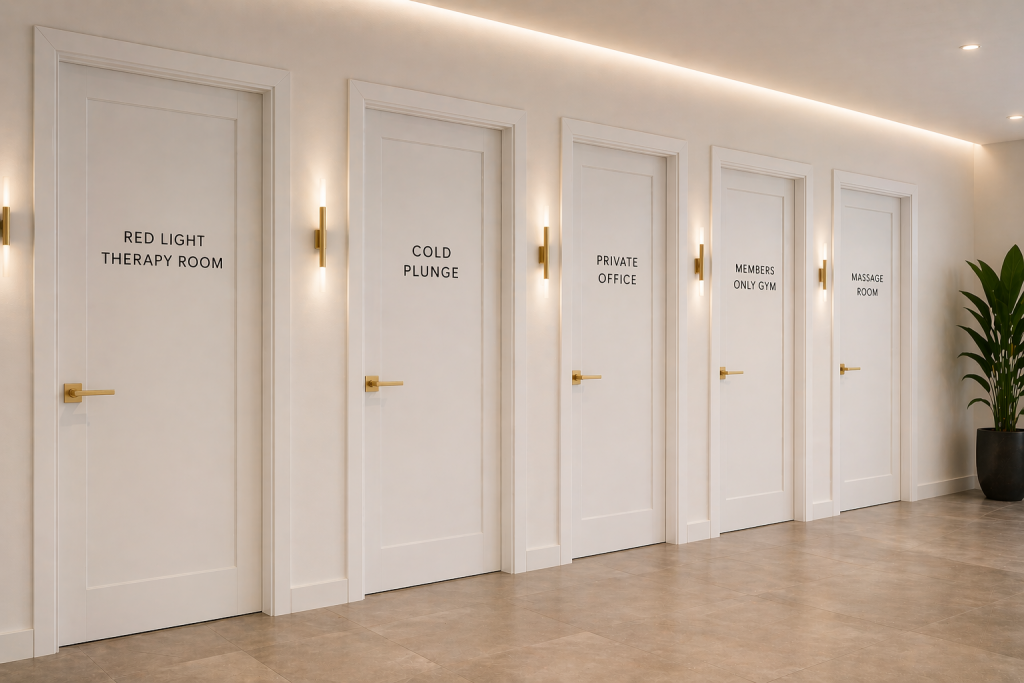
Illustration for conceptual purposes. Actual facilities and experiences at The Leela Vida may vary.
A serious routine starts to break the moment the environment becomes unpredictable. A private wellness club Barbados professionals can rely on is not defined by amenities alone. It is defined by control – over noise, crowding, access, timing, and the quality of each part of the day.
For professionals whose output depends on clarity and consistency, the usual model rarely holds up. Public gyms create friction. Standard coworking spaces dilute focus. Recovery becomes occasional rather than built in. Meals are handled in gaps, not with intention. The issue is not convenience. It is fragmentation.
What a private wellness club in Barbados should actually provide
The term is often used loosely. In practice, a private wellness club should function as a structured environment where physical training, recovery, work, and nutrition support the same objective. That objective is sustained performance.
This changes the standard by which the space is judged. Equipment matters, but so does access. Design matters, but so does how many people are allowed into the environment. Privacy matters, but so does whether privacy is protected operationally, not just implied in branding.
A high-functioning club should allow a member to move through training, recovery, and work without resetting mentally each time. If each transition introduces noise, waiting, or distraction, the environment is not supporting performance. It is consuming it.
In Barbados, this matters more than many people expect. For local executives, founders, and professionals spending extended time on the island, the challenge is often not a lack of options. It is a lack of settings built for disciplined use. There are places to exercise, places to work, and places to eat. Fewer spaces are designed to hold those elements together in a controlled way.
Why private matters more than luxury
Privacy in this context is not about exclusivity for its own sake. It is operational.
A crowded room changes behavior. So does ambient conversation, inconsistent etiquette, or the sense that a space is designed for volume rather than standards. Even high-quality facilities lose value when they cannot protect concentration.
A membership cap is one of the clearest indicators of whether a club understands this. Without one, the environment eventually shifts toward throughput. With one, the club can preserve calm, maintain access, and keep the experience predictable.
That predictability is not a minor benefit. It is what allows routine to hold. A professional who trains at the same time each morning, uses recovery with intention, works in a controlled setting, and eats without interruption is not simply checking boxes. They are reducing decision load and protecting output.
Luxury language often obscures this point. Soft finishes and ocean views have value, but they are secondary. If the room is crowded, the workflow is broken, or the atmosphere invites distraction, the core standard has not been met.
The structure of a performance-led environment
A private wellness club Barbados professionals take seriously should be organized around sequence, not isolated services.
Training without public gym friction
A private performance gym should support focused work. That means proper equipment, enough space, and an atmosphere that does not interrupt pace. It also means avoiding the usual public gym variables – waiting for stations, casual traffic, unnecessary conversation, and a layout built for general use rather than intentional training.
For members who train consistently, this is where much of the value begins. The session is cleaner, timing is protected, and mental energy stays directed toward the work itself.
Recovery as part of the schedule
Recovery is often treated as optional because most environments make it inconvenient. When recovery is integrated into the same setting, it becomes part of the operating rhythm rather than an occasional add-on.
That distinction matters. Structured recovery supports repeatability. It helps maintain physical capacity, reduces unnecessary drag across the week, and allows training volume and work demands to coexist more effectively. For professionals balancing long days and high cognitive output, that is practical, not indulgent.
Workspace that preserves momentum
The transition from training to work is where many routines break down. Commuting across locations, entering noisy cafés, or settling into shared desks with constant movement all create reset costs.
An executive workspace within the same environment solves a specific problem. It allows the member to move directly into focused work while maintaining the calm and discipline established earlier in the day. This is less about convenience than continuity.
Nutrition that supports output
Food becomes inefficient when it is handled reactively. A café within the club only adds value if it supports the member’s broader routine – well-prepared meals, clear nutritional intent, and no need to leave the environment to eat properly.
Again, the principle is not indulgence. It is the removal of friction from a system that depends on consistency.
Who benefits most from this model
Not everyone needs a private club. Some people prefer energy, variety, and social settings. Others are comfortable piecing their day together across multiple locations.
But for a narrower group, fragmentation carries a measurable cost. Executives with compressed schedules, founders managing constant decision flow, and professionals who treat physical performance as part of their work capacity tend to value control over novelty.
That audience usually recognizes the difference quickly. They are not looking for entertainment. They are looking for an environment that does not interfere with standards they already keep.
This is also why a private club is not the same as a premium gym or a refined coworking space. A premium gym may still be crowded and socially driven. A refined workspace may still lack any meaningful integration with training or recovery. The distinction is structural.
The trade-offs to consider
A private model is not designed for broad appeal. That is part of its value, but it is still a trade-off.
A strict membership cap means access is limited by design. The atmosphere may feel too restrained for those who prefer a more casual or social environment. A performance-led club also asks something of the member. It works best for people who already value routine and will use the structure well.
There is also the question of pace. Some members want flexibility above all else. Others need a setting that reinforces discipline. The right fit depends on whether the environment matches the way the person intends to operate, not just the features they say they want.
A clearer standard for choosing a private wellness club in Barbados
If you are assessing a private wellness club in Barbados, the useful questions are straightforward.
Is the environment calm at peak hours, or only in marketing materials? Is privacy protected by actual limits on access? Can training, recovery, work, and nutrition happen in one sequence without disruption? Does the space help preserve routine across months, not just create a strong first impression?
The strongest clubs answer those questions through operations, not language.
One example is The Leela Vida, which is positioned not as a gym or coworking space, but as a private performance environment. That distinction matters because it reflects how the day is meant to function. Members train, recover, work, and eat within one controlled setting, with a strict cap that protects calm and consistency.
That model will not appeal to everyone. It is not meant to. But for professionals who understand the cost of interruption, it sets a more useful standard than the usual wellness offering.
A well-designed environment does not motivate you with noise or novelty. It protects the conditions under which discipline can keep working.