
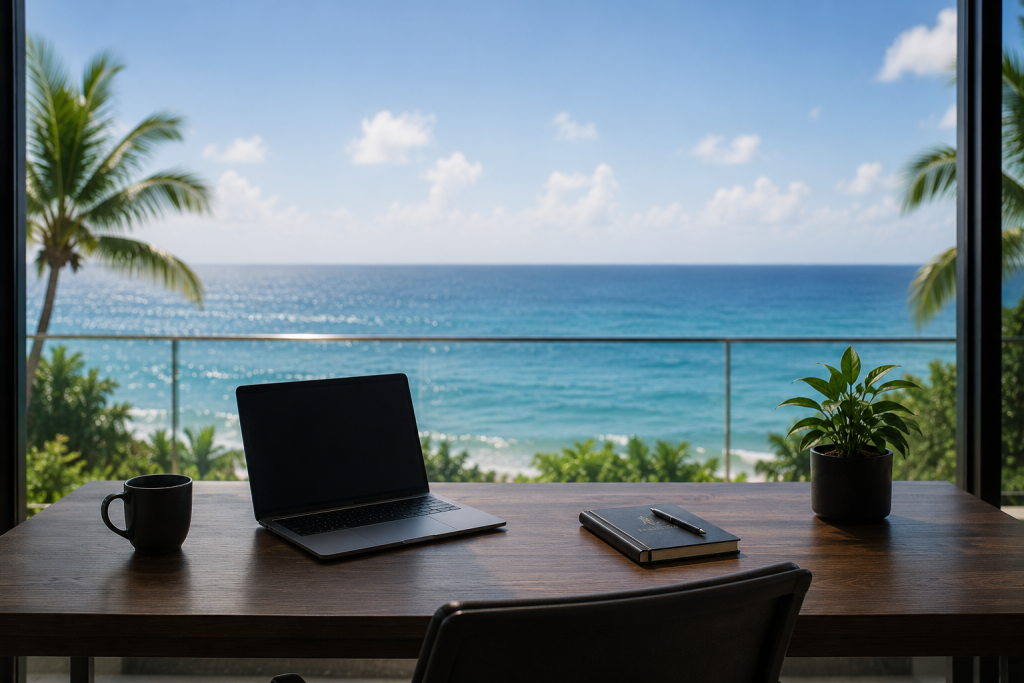
Illustration for conceptual purposes. Actual facilities and experiences at The Leela Vida may vary.
The difference is usually audible before it becomes measurable. A call carried across a shared room, a chair dragged across concrete, casual conversation that arrives just as concentration narrows. For people whose work depends on judgment, analysis, and sustained attention, the best quiet workspaces for professionals are not a preference. They are part of the operating environment.
Quiet, however, is often misunderstood. It is not simply the absence of noise. A useful workspace controls interruption, protects privacy, and supports a repeatable standard of output. It allows a professional to move from deep work to calls to decision-making without having to rebuild focus each time the room changes around them.
What makes a workspace genuinely quiet
Many spaces market themselves as calm because they use soft finishes, neutral colors, or low music. That is not the same as a quiet working environment. Professionals usually need three conditions at once: acoustic control, behavioral discipline, and spatial separation.
Acoustic control is the obvious part. Sound should be contained rather than merely softened. Phone calls should not bleed across desks. Doors should close properly. Mechanical noise, café traffic, and street exposure should be limited. If a room is visually polished but you can follow someone else’s meeting from fifteen feet away, it is not quiet in any practical sense.
Behavioral discipline matters just as much. A workspace can be beautifully designed and still fail because the people using it treat it as a lounge. Quiet environments depend on shared standards. People arrive with purpose, keep movement controlled, and understand that another person’s concentration is not background scenery.
Spatial separation is the third piece. Focus work, private calls, meetings, and recovery between tasks should not all happen in the same open room. Once every activity is layered into one space, friction follows. The best environments give each part of the day its place.
The best quiet workspaces for professionals are structured, not just silent
Silence without structure can still be inefficient. A hotel lobby may be quieter than a coffee shop, but it is rarely built for four hours of concentrated work, a confidential call, and a transition into the next part of the day. The question is not whether a place feels peaceful for ten minutes. It is whether it can support a serious working rhythm.
That is why the best quiet workspaces for professionals tend to share a more disciplined logic. Access is controlled. Occupancy is limited. Seating is intentional. There is a clear distinction between communal areas and private ones. Food and movement are available without forcing a person back into public, distracting settings.
This becomes more important for executives, founders, and independent professionals whose day is not segmented by someone else’s schedule. If you structure your own output, the environment must hold that structure with you. Otherwise, small disruptions compound into a slower day.
Common workspace options and where they fail
The usual options each solve one problem while creating another.
Coffee shops offer convenience, but almost never consistency. Noise rises and falls unpredictably. Seating is temporary by nature. Calls are either intrusive or impossible. Even when the room is relatively quiet, it is still public space with public turnover.
Traditional coworking spaces improve on this by offering desks, meeting rooms, and better internet. But many are built around density and social energy. That works for networking and light collaboration. It works less well for concentrated work that requires privacy, restraint, and low interruption. A busy coworking floor often carries the same cognitive drag as any shared office, only packaged more attractively.
Home offices are useful when domestic conditions are stable and the work itself is contained. For some professionals, that remains the strongest option. But home can also blur boundaries. Deliveries, family movement, household noise, and the subtle pull of personal tasks all interfere with continuity. A home office is only as effective as the structure around it.
Hotels and private clubs can provide temporary calm, especially for traveling professionals. The trade-off is variability. One property may support serious work, another may be optimized for hospitality first and productivity second. Quiet is possible, but not always dependable.
What to look for in quiet workspaces for professionals
The strongest environments are usually selective in ways that matter operationally. They are not trying to accommodate every work style. They are designed around a narrower standard.
First, look at occupancy. A room can be well designed and still become unusable if too many people share it. Lower density protects both sound levels and decision quality. When every desk is occupied and every call room is booked, even a premium space becomes reactive.
Second, assess privacy. This is not only about confidential information. Privacy also protects composure. Professionals work better when they are not exposed to constant peripheral activity, overheard conversations, or the sense that every task is being performed in public.
Third, consider whether the space supports a full day, not just a work block. If you need to leave for food, reset elsewhere, or manage recovery in a separate location, your day becomes fragmented. Fragmentation is expensive. It costs attention, time, and consistency.
Fourth, watch for the quality of rules. Good quiet spaces are not policed aggressively. They are simply structured well enough that standards hold. Access, layout, and membership model often do more than signage ever can.
Why integrated environments outperform stand-alone offices
For many professionals, the real issue is not finding a silent desk. It is maintaining clarity across an entire day. Work output is affected by physical fatigue, poor transitions, irregular meals, and the drag that comes from moving between disconnected spaces.
This is where integrated environments become more useful than standard office solutions. When workspace, training, recovery, and nutrition are handled within one controlled setting, the professional spends less time switching contexts and more time maintaining a consistent level of function. The benefit is not convenience in the casual sense. It is continuity.
A founder may begin with training early, move directly into focused work, take a private call, reset physically, eat properly, and continue the day without entering a crowded gym, a public café, or a noisy shared office. That sequence preserves decision-making capacity. It also reduces the friction that usually accumulates by midday.
In Barbados, that model has particular relevance for professionals spending extended time on the island and expecting more than temporary hospitality or conventional coworking. A private performance environment such as The Leela Vida reflects a different standard: limited occupancy, disciplined use, executive workspace, recovery, and nutrition held within one system. For the right individual, that arrangement is more practical than assembling the day from separate locations.
It depends on the type of work you do
Not every professional needs the same kind of quiet. Someone writing strategy documents, reviewing legal material, or handling financial analysis may need longer periods of uninterrupted depth. Someone else may spend much of the day on calls and require acoustic privacy more than silence at a desk.
That distinction matters. An open quiet room may suit focused individual work but fail for a call-heavy schedule. A private office may support confidentiality but feel too closed if collaboration is part of the day. The best choice depends on whether your main risk is distraction, lack of privacy, or fragmentation between tasks.
It also depends on duration. If you need a place for occasional use, flexibility may matter more than integration. If you are building a weekly routine, consistency becomes the higher priority. The environment should reduce variation, not add to it.
A simple standard for choosing well
A quiet workspace should make the day easier to hold together. That is the practical test. If the setting protects attention, supports privacy, and reduces the number of transitions required to stay effective, it is doing its job. If it looks refined but leaves you adapting to noise, crowding, or constant movement, it is not.
Professionals usually know the difference quickly. The right space does not ask for tolerance. It allows concentration to remain intact, decisions to stay clear, and routine to continue without unnecessary friction.
Choose the environment that lets your standards remain unchanged from the first hour to the last. That is usually where the real work gets done.
FAQs
Why work from an office with an ocean view?
An oceanfront workspace helps reduce distractions, improve focus, and create a calmer environment for deep work. Many professionals find that a peaceful setting supports productivity throughout the day.
Who are oceanfront workspaces best suited for?
They are ideal for executives, business owners, remote workers, consultants, digital professionals, and anyone who values a quiet, professional environment away from busy cafés and shared offices.
Does The Leela Vida offer private workspaces?
Yes. The Leela Vida offers private executive work pods designed for focused work, virtual meetings, confidential calls, and uninterrupted productivity, all overlooking the Caribbean Sea.
Can I combine work with fitness and wellness?
Yes. Members and eligible pass holders can combine executive workspace with access to premium fitness and wellness facilities, creating a seamless balance between work, training, and recovery.
Where is The Leela Vida located?
The Leela Vida is located in Christ Church, Barbados, offering a unique oceanfront setting for professionals seeking executive workspace, wellness, and fitness in one destination.