
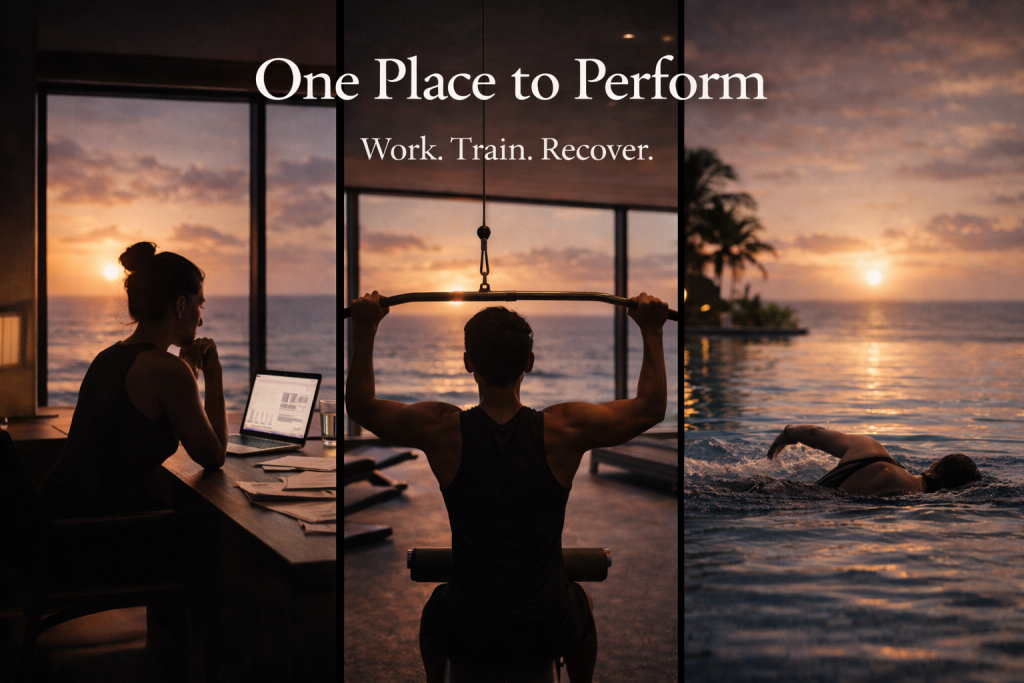
Illustration for conceptual purposes. Actual facilities and experiences at The Leela Vida may vary.
Why Modern Professionals Are Bringing Work, Fitness and Recovery Together
Modern professionals no longer struggle because they lack discipline or ambition. Most already understand the importance of exercise, good nutrition, and maintaining their health. The real challenge is fragmentation. Work happens in one location, training in another, recovery somewhere else, and meaningful focus is constantly interrupted by travelling between them. Every change of environment demands a mental reset. Every journey introduces new distractions, decisions, and delays. Over time, these interruptions consume more cognitive energy than people realise. It is rarely the work itself that creates exhaustion. More often, it is the constant switching between disconnected environments. Today’s executives, entrepreneurs, and remote professionals operate across multiple time zones, carry significant responsibility, and rely on sustained mental clarity. The traditional model of separating work, fitness, and recovery was built for a different generation. Modern performance requires a more integrated approach.
Why Integration Has Become a Competitive Advantage
Integration is no longer simply a lifestyle preference. For many professionals, it has become a practical requirement. When work, movement, and recovery exist within a single environment, unnecessary transitions disappear. A focused work session flows naturally into training. Recovery follows immediately afterwards. The body and mind return to a productive state without the disruption of travelling across the island or adapting to multiple settings throughout the day. This continuity protects both physical and mental energy. Decision-making remains sharper, routines become easier to maintain, and consistency improves naturally because there are fewer opportunities for the day to fall apart. In Barbados, where many professionals deliberately relocate to improve their quality of life, this approach has particular value. Increasingly, successful people are asking not how much they can fit into a day, but how well their environment supports sustained performance from morning until evening.
Better Work Requires Better Environments
The nature of work has changed permanently. Productivity is no longer tied to a traditional office or a fixed desk. Professionals move between virtual meetings, strategic planning, client calls, travel, and independent work throughout the day. What matters now is not simply having somewhere to sit with a laptop. It is having an environment that protects concentration. Many coworking spaces are designed around activity rather than focus. Conversations, phone calls, constant movement, and shared social areas create a level of background distraction that slowly erodes attention. While these environments often appear productive, they rarely support deep thinking. High-performing professionals require something different. They value quiet, privacy, and consistency because these conditions allow better decisions to be made. Executive work pods and carefully designed business lounges provide more than somewhere to work. They create an environment where attention remains protected, allowing meaningful work to be completed with greater clarity and in less time.
Movement Is Part of Professional Performance
For many professionals, exercise is still viewed as something that happens outside the working day. Increasingly, this distinction no longer reflects reality. Physical movement directly influences cognitive performance. A structured workout improves circulation, reduces accumulated stress, restores alertness, and often produces clearer thinking than passive rest ever could. The challenge is not recognising these benefits. The challenge is maintaining consistency when training requires another journey, another change of clothes, another parking space, and another adjustment to an already demanding schedule. When exercise becomes another logistical challenge, it gradually shifts from being essential to being optional. Integrated environments change this completely. Professionals move naturally from focused work into structured training before returning to their responsibilities with renewed energy. Fitness becomes an extension of productivity rather than competing with it. Over time, this simple change creates significant improvements in both physical health and professional performance.
Recovery Is Where Long-Term Performance Is Protected
Most people understand the value of hard work. Many appreciate the importance of regular exercise. Far fewer recognise that recovery is what allows both to remain sustainable. Performance does not improve during periods of effort alone. It improves when the body has the opportunity to repair, adapt, and restore itself. Without structured recovery, fatigue accumulates quietly. Mental clarity declines, sleep quality deteriorates, stress becomes more difficult to manage, and physical progress slows despite increasing effort. Recovery is therefore not passive or indulgent. It is a deliberate process that supports long-term resilience. Cold plunge therapy, infrared heat, red light therapy, controlled breathing, and quiet recovery environments all contribute to regulating the nervous system and preparing the body for the next period of high performance. When recovery is separated from the rest of the day, it is often skipped because time becomes limited. When recovery exists alongside training and work, it becomes an effortless part of a consistent routine.
The Hidden Cost of Constant Transitions
Many professionals invest considerable effort into improving each individual part of their day. They optimise their meetings, refine their training programmes, improve their nutrition, and invest in recovery techniques. What often goes unnoticed is the cost of moving between these activities. Travelling across the island, finding parking, navigating different facilities, waiting for equipment, and repeatedly adjusting to new environments all consume attention without adding value. These hidden interruptions gradually reduce productivity because they create constant mental switching. Integrated environments remove this invisible burden. Moving from work to training takes minutes rather than an hour. Recovery naturally follows exercise without requiring another appointment elsewhere. Returning to focused work becomes easier because the environment remains familiar and uninterrupted. While each transition may save only a small amount of time, these improvements accumulate significantly over weeks, months, and years.
Why One Environment Changes Everything
When work, fitness, recovery, and wellbeing exist together within one carefully designed environment, the entire rhythm of the day changes. Decision fatigue decreases because fewer choices need to be made. Professionals no longer negotiate whether there is enough time to train or whether recovery can wait until tomorrow. Everything required to support performance already exists within the same location. This simplicity is one of the greatest luxuries available to busy professionals. It protects mental energy for decisions that genuinely matter while allowing healthy routines to become almost automatic. The true value of integration is not convenience in the traditional sense. It is control. Control over time, control over attention, and ultimately control over long-term performance.
A Better Model for Professionals in Barbados
Barbados continues to attract executives, entrepreneurs, business owners, and remote professionals seeking a lifestyle that combines business success with personal wellbeing. Many discover, however, that their daily routine still requires moving between separate offices, fitness centres, recovery facilities, cafés, and meeting locations. The island offers an exceptional quality of life, but the traditional model remains fragmented. A modern performance environment brings these functions together. Private workspaces support focused thinking. A luxury fitness center provides structured training. Recovery facilities restore both body and mind. Healthy dining supports consistent nutrition. Meeting spaces allow professional responsibilities to continue without interruption. Together, these elements create a daily rhythm that is calmer, more productive, and significantly easier to sustain.
How The Leela Vida Brings Everything Together
The Leela Vida has been designed around the principle that professionals perform best when unnecessary complexity is removed from their day. Rather than functioning solely as a luxury fitness center, it combines executive workspaces, structured fitness, clinical-grade recovery facilities, healthy dining, and an oceanfront environment within one carefully managed setting. Every space has been designed to support the next. Members move naturally from focused work to training, from training into recovery, and then back into productive work without leaving the property. Limited membership preserves tranquillity, reliable access, and privacy while ensuring the environment remains consistent throughout the day. This integrated approach reflects the changing expectations of modern professionals who increasingly value environments that support every aspect of their performance rather than treating work, health, and recovery as separate priorities.
A Different Way to Structure the Day
The future of professional performance will not be determined by working longer hours or training harder. It will be determined by creating environments where every part of the day supports the next. Professionals who protect their attention, physical health, and recovery gain an advantage that compounds over time because consistency becomes easier to maintain. Their environment becomes an active contributor to success rather than another obstacle to overcome. That philosophy sits at the heart of The Leela Vida. It is designed as one integrated environment where work, fitness, recovery, and wellbeing exist together, allowing professionals in Barbados to maintain the clarity, discipline, and consistency required for long-term success.