
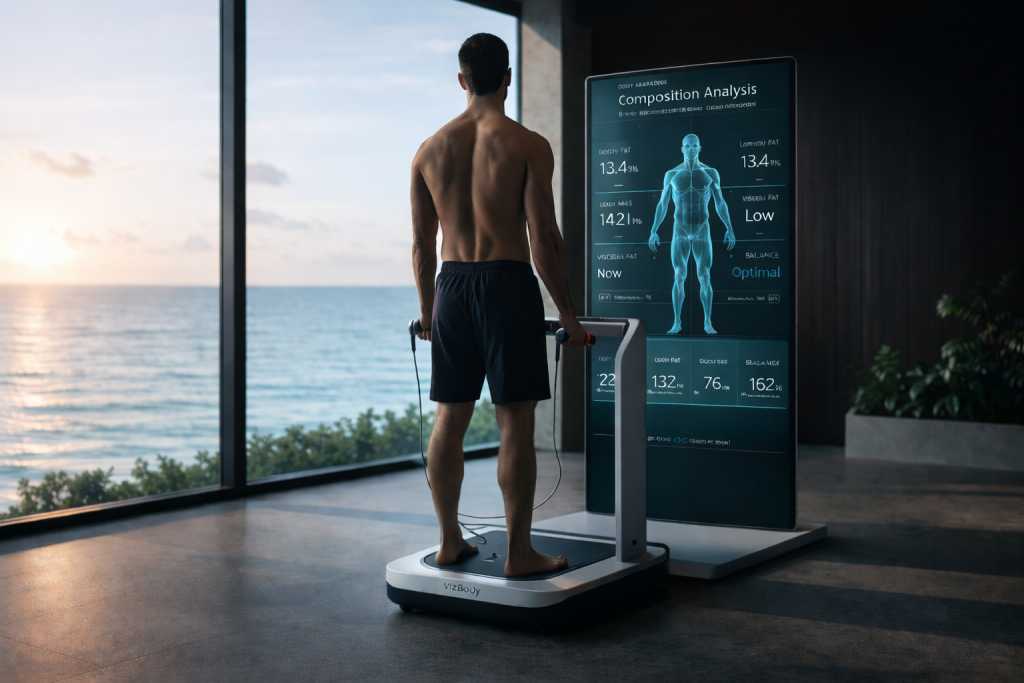
Illustration for conceptual purposes. Actual facilities and experiences at The Leela Vida may vary.
Why Scale Weight Fails Executives
Most professionals still rely on body weight as the primary measure of progress. This approach is outdated and lacks precision. A scale does not distinguish between fat, muscle, water retention, or inflammation. As a result, it produces misleading signals that can lead to poor decisions. Two individuals can weigh the same yet operate at completely different levels of performance, energy, and resilience. For an executive, this level of ambiguity is unacceptable.
A drop in weight may appear positive, but without context, it often reflects muscle loss rather than fat reduction. This has direct consequences. Muscle loss reduces metabolic efficiency, lowers strength, and weakens long-term physical stability. Over time, this leads to fatigue, slower recovery, and reduced output. Tracking weight alone removes the detail required to make informed adjustments, making it a weak and unreliable metric for anyone focused on performance.
What Body Composition Reveals
Body composition analysis provides a structured breakdown of the body into measurable components. These include body fat percentage, lean muscle mass, visceral fat levels, and hydration status. Each of these metrics offers insight into how the body is functioning beneath the surface. Instead of relying on appearance or assumptions, you gain a clear view of what is actually changing over time.
This allows for targeted decision making. If fat is not reducing, training or nutrition can be adjusted. If muscle mass is declining, recovery and resistance training can be corrected. This removes guesswork entirely. Over time, this level of precision creates consistent improvement, where each adjustment is based on data rather than perception. For individuals who value control, this becomes a necessary standard.
The Executive Performance Advantage
High-performing professionals operate in environments where data drives decisions. Financial performance, operational efficiency, and strategic planning are all built on measurable inputs. Health should follow the same principle. Without data, there is no control. Without control, results become inconsistent.
Body composition tracking introduces structure into health. It aligns physical performance with the same disciplined mindset applied in business. When an executive understands how their body is changing at a detailed level, they can make decisions with confidence. Training becomes more effective. Nutrition becomes purposeful. Recovery becomes strategic. This creates alignment between physical capacity and professional demands.
Why Precision Drives Better Outcomes
Subjective measurement leads to inconsistent results. Relying on how you feel or how you look introduces variability that cannot be controlled. Energy levels fluctuate. Visual changes are gradual and often misleading. Without clear data, it becomes difficult to determine whether progress is being made or lost.
Precision changes this entirely. Measurable changes in body fat, muscle mass, and metabolic efficiency provide clear direction. For example, reducing body fat while maintaining or increasing muscle creates a stronger, more efficient system. This improves energy stability, supports cognitive clarity, and enhances recovery capacity. These changes are not immediate, but they compound over time, creating long-term advantages that support sustained performance.
The Role of Structured Assessment
The environment in which measurement takes place is critical. Inconsistent conditions produce unreliable data. Public gyms and general fitness environments rarely offer the control required for accurate tracking. Variations in hydration, timing, and equipment can distort results, making it difficult to identify real progress.
A structured assessment protocol eliminates this variability. Measurements are taken under consistent conditions, using the same equipment and timing. This produces reliable data that can be compared over time. For professionals who rely on accuracy in every other area of life, this level of consistency is expected. It ensures that every decision made is based on clear, repeatable information.
A New Standard for Measurement
Body composition analysis shifts the focus from appearance to performance. It replaces estimation with data and removes emotional bias from the process. This creates a more disciplined approach to health, where decisions are based on measurable outcomes rather than assumptions.
At The Leela Vida, this approach is integrated into a broader system. Training, recovery, and measurement operate together within a controlled environment designed for high-performing individuals. This reflects a wider shift in the market, where professionals seek environments that reduce cognitive load and support structured performance. The objective is not short-term change, but sustained, measurable improvement that aligns with long-term health and professional output.