
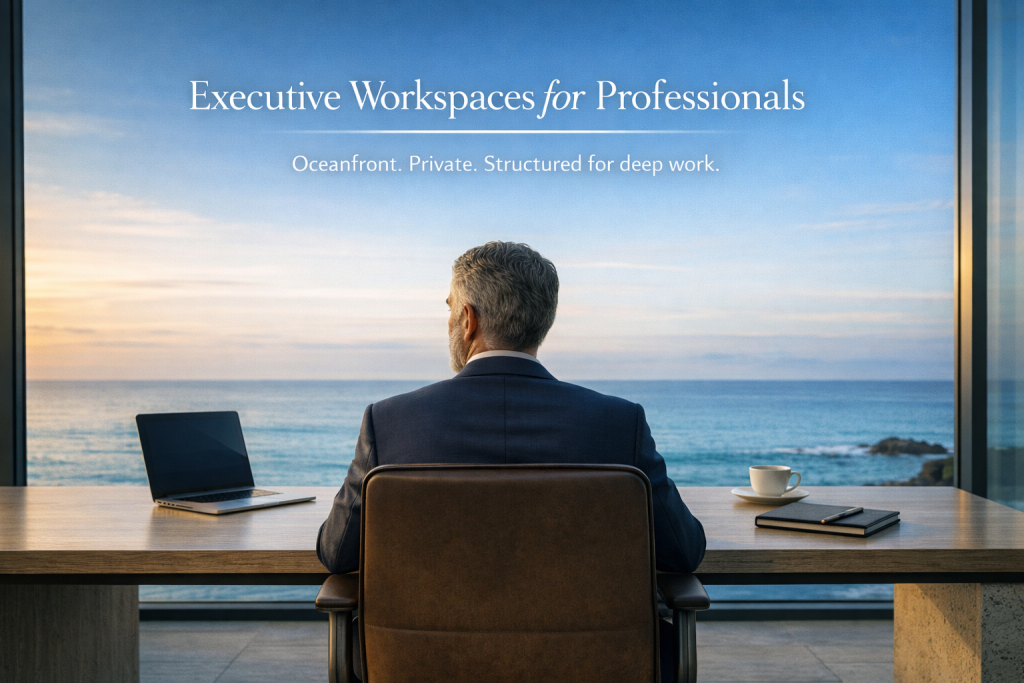
Illustration for conceptual purposes. Actual facilities and experiences at The Leela Vida may vary.
A serious workday can be disrupted by small things long before a major issue appears. Noise from the next table. A phone call taken too close to your desk. Time lost moving between training, meetings, meals, and a place to think clearly. For people who operate on structure, executive workspaces for professionals are not a visual upgrade. They are a functional requirement.
The difference is not aesthetic. It is operational. A workspace either protects concentration or it drains it. It either supports continuity across the day or forces constant adjustment. Professionals with decision-making responsibility tend to notice this quickly because the cost is measurable in reduced clarity, slower response time, and fragmented attention.
What executive workspaces for professionals are meant to do
A proper executive workspace is designed to reduce interference. That begins with privacy, but privacy alone is not enough. The room, the pacing, the level of occupancy, and the behavior expected within the environment all affect performance.
In practical terms, executive workspaces for professionals should support deep work, confidential conversation, and transitions between tasks without forcing mental reset each time. The standard is not whether a person can technically work there. The standard is whether the environment allows high-value work to continue without friction.
This is where many shared offices fall short. They provide access to a desk, internet, and coffee, but they rarely provide control. Activity is constant. Occupancy changes by the hour. The atmosphere depends on whoever happens to be in the room. For some people, that variability is acceptable. For executives, founders, and operators managing sensitive decisions, it usually is not.
The cost of a workspace that interrupts your routine
Most professionals underestimate the impact of fragmented environments because each interruption seems minor on its own. A noisy setting might not end a meeting, but it changes how the meeting is conducted. An overcrowded room might not stop work entirely, but it raises the effort required to maintain focus.
Over time, these conditions create drag. Work is divided into shorter windows. Calls are postponed. Strategic thinking is replaced by reactive task management. Even basic choices like when to eat, when to train, or when to recover become less consistent because the day has no stable structure.
That trade-off matters more for people who are balancing multiple demands. If you are moving between financial decisions, team communication, physical training, and travel logistics, a casual workspace is rarely neutral. It adds load. The environment becomes something to manage, when it should be doing the opposite.
The operational features that matter most
The best executive environments are often defined by restraint. They do not attempt to entertain. They remove variables.
Privacy is the first requirement. That includes physical spacing, acoustic control, and a membership or access structure that keeps traffic predictable. A room can look refined and still fail if conversations carry too easily or if the people around you are not working to the same standard.
The second requirement is calm. Calm does not mean passive. It means the space is orderly enough that attention is not constantly pulled outward. Lighting, layout, and occupancy all contribute to that. So does the absence of unnecessary social activity.
The third requirement is continuity. A workspace should not exist in isolation from the rest of the day. For professionals who train, manage recovery, and maintain tight schedules, the highest-value environment is one where work can sit within a larger routine rather than compete with it.
This is where integration matters. If a person needs to finish a planning block, take a private call, eat properly, and return to work with the same level of focus, the surrounding environment should support that sequence without delay.
Why privacy changes the quality of work
Privacy is often treated as a preference. In practice, it changes behavior.
People work differently when they are not being overheard, interrupted, or visually monitored by a rotating public audience. Sensitive conversations become more direct. Thinking becomes less performative. Decisions can be examined properly without the pressure that comes from an exposed setting.
For professionals handling investor communication, legal matters, senior hiring, financial planning, or confidential strategy, this is not a small distinction. Public coworking environments can be useful for mobility, but they are rarely built for discretion. The issue is not only security. It is the reduction in precision that happens when people are forced to edit themselves because the environment is too open.
A controlled workspace allows the opposite. It supports directness. That tends to improve both speed and quality.
The relationship between workspace and physical performance
For many high-performing professionals, work is only one part of a disciplined day. Training, recovery, and nutrition are not separate interests. They are maintenance systems that protect output over time.
A fragmented environment forces these priorities into conflict. Work expands and displaces training. Travel between locations reduces usable time. Meals become improvised. Recovery is postponed until it disappears from the schedule entirely.
A better model places executive workspaces within a broader performance setting. That arrangement reduces transition costs and protects routine. A person can train early, recover properly, move into focused work, eat without leaving the environment, and continue the day with less disruption. The gain is not convenience for its own sake. The gain is consistency.
This matters in Barbados, where many executives, remote operators, and extended-stay residents are structuring their work around both local conditions and international schedules. When the day includes calls across time zones, physical training, and concentrated work blocks, the environment needs to support all three with discipline.
What to evaluate before choosing a workspace
Not every professional needs the same level of control. Some can tolerate a degree of noise or variability if they only need a room for a few hours. Others require a setting that holds a consistent standard every day.
The question is not whether a workspace appears premium. The question is whether it protects the way you work.
Start with occupancy. If the environment is frequently crowded, concentration will depend on luck. Then consider access. Open public traffic usually weakens privacy and predictability. After that, look at adjacency. If you need to move between work, training, recovery, or meals, distance matters more than branding.
It is also worth considering whether the space supports a long-term routine or only short-term use. Many environments work well for occasional sessions but fail under daily repetition. The flaws become obvious when the novelty wears off and the actual workflow begins.
A controlled environment is not for everyone
There is a trade-off in highly structured spaces. They are not designed for casual social energy, spontaneous networking, or public visibility. Some people want that. They work better with movement around them, or they prefer the flexibility of informal settings.
Executive workspaces for professionals are better suited to individuals who already know how they operate. They tend to value consistency over variety, discretion over access, and routine over atmosphere. For that group, the right environment does not feel restrictive. It feels stable.
This is also why membership limits matters. A capped environment protects the quality of use. It reduces noise, controls traffic, and keeps the setting aligned with the purpose it was built to serve. At The Leela Vida, that principle extends across the broader environment, where workspace, training, recovery, and nutrition are arranged to support a clear daily structure rather than separate, competing tasks.
The right workspace should allow a professional to move through the day without negotiating basic conditions each hour. That is a higher standard than comfort. It is a question of whether the environment respects the value of focused time. When it does, work becomes more exact, decisions become cleaner, and routine holds its shape under pressure.
Choose the setting that asks the least from your attention, so your attention can stay where it belongs.