
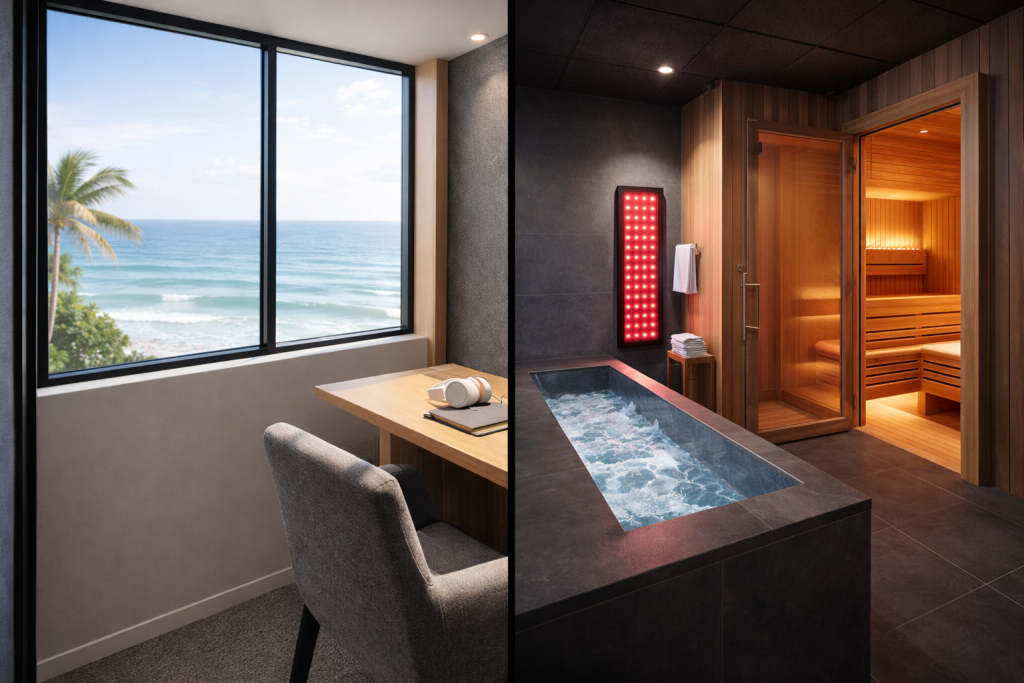
Illustration only. Conceptual representation of focus and recovery without burnout at The Leela Vida.
Focus and Recovery Without Burnout. Why High Performers Need Boundaries, Not Balance
Focus and recovery determine whether high performers sustain clarity or slowly slide into burnout.
Many professionals believe burnout comes from excess work. They assume the solution lies in better balance. Fewer hours. More breaks. Lighter schedules. In reality, burnout emerges when focus and recovery lose clear boundaries. When work, training, and stimulation bleed together, the nervous system never fully resets.
This article explains why boundaries protect focus and recovery better than balance, and why high performers increasingly design environments that separate effort from restoration.
Why Balance Is the Wrong Goal
Balance suggests equal distribution. Work here. Life there. Training somewhere in between. High performers rarely live this way. Their days expand and contract. Demands spike unpredictably. Travel disrupts routine. Balance becomes an abstract ideal rather than a practical system.
What sustains performance is not balance. It is containment.
Boundaries define where effort begins and where it ends. Focus and recovery depend on these limits.
Focus and Recovery Require Separation
The nervous system responds to context. When environments blur, regulation fails. Working where you relax. Training where you socialize. Recovering where stimulation continues.
This overlap keeps the system partially alert. Focus fragments. Recovery remains incomplete.
High performers who protect focus and recovery separate environments deliberately. They do not rely on willpower. They rely on design.
Why Burnout Starts Invisibly
Burnout does not announce itself. Focus degrades first.
Decision speed slows. Mental clarity dulls. Emotional tolerance narrows. Productivity continues, but effort increases. This hidden phase can last months.
The cause is rarely workload alone. It is continuous activation without true recovery.
The Cost of Boundaryless Living
Modern lifestyles erase boundaries.
Messages arrive during training. Meetings interrupt meals. Screens follow people into recovery time. Even leisure becomes stimulating.
The nervous system never fully disengages. Focus and recovery decline quietly.
Over time, effort produces diminishing returns.
Why Focus Collapses Before Energy
Focus requires regulation. When the nervous system remains alert, attention narrows. Distractions multiply. Small interruptions feel disruptive.
Energy may still exist. Focus does not.
This is why professionals feel tired yet restless. They struggle to concentrate despite motivation.
Recovery restores focus before it restores energy.
Why Recovery Fails in Open Environments
Open environments increase vigilance. The brain scans constantly. Noise, movement, and social presence demand attention.
Even passive exposure drains cognitive reserves. Recovery remains superficial.
Focus and recovery improve when vigilance drops completely.
Boundaries Reduce Cognitive Load
Every unplanned interaction creates micro decisions. Where to look. When to respond. What to ignore.
Boundaries eliminate these decisions. Private environments simplify choices. The nervous system relaxes. Focus stabilizes.
Simplicity restores clarity.
Why High Performers Design Their Day
High performers do not rely on balance. They design transitions.
Work ends cleanly. Recovery begins intentionally. Training occurs in contained blocks. Environments signal what the body should do next.
These signals matter more than motivation.
Focus and Recovery as a System
Focus and recovery work together. One protects the other.
Without focus, effort scatters.
Without recovery, focus collapses.
Boundaries allow both to function.
Why Rhythm Beats Flexibility
Flexibility feels attractive. In practice, it keeps the nervous system alert.
Predictable routines create safety signals. When the body knows what comes next, regulation improves. Focus returns faster. Recovery deepens.
Rhythm protects long term performance.
The Role of Physical Space
Space communicates expectations.
A workspace signals output.
A training space signals exertion.
A recovery space signals release.
When spaces overlap, signals conflict. Focus and recovery weaken.
High performers increasingly choose environments that respect these distinctions.
Why Motivation Is a Poor Strategy
Motivation fluctuates. Boundaries endure.
Professionals who rely on motivation to rest or focus exhaust themselves. Those who rely on structure conserve energy.
Design replaces discipline.
Focus and Recovery in Leadership
Leadership depends on clarity. Poor boundaries create reactive decision making. Emotional regulation declines. Judgment slows.
Recovery restores leadership quality before performance metrics change.
Boundaries protect leadership capacity.
Training Suffers Without Recovery Boundaries
Physical training demands nervous system precision. When recovery remains incomplete, coordination suffers. Strength fluctuates. Injury risk rises.
Focus improves movement quality. Recovery protects consistency.
Boundaries support better training outcomes with less effort.
Why Private Spaces Matter
Privacy reduces social monitoring. The nervous system stops anticipating interaction. Regulation deepens.
This is not luxury. It is function.
Focus and recovery improve when the system feels unobserved.
The Illusion of Multitasking
Multitasking fractures attention. Focus becomes shallow. Recovery never begins.
High performers limit context switching. They move fully from one state to another.
Boundaries enable this transition.
How High Performers Prevent Burnout
They do not seek balance.
They protect edges.
Clear start points.
Clear end points.
Clear environments.
Focus and recovery stabilize when effort has limits.
Daily Recovery Does Not Require Time
Recovery quality matters more than duration.
Ten minutes of true separation restores more focus than hours of passive downtime.
Boundaries make recovery efficient.
Focus Returns Before Motivation
As recovery improves, focus stabilizes first. Motivation follows naturally. Work feels lighter. Training feels cleaner.
This sequence matters.
Longevity Depends on Boundaries
Careers end early not from ambition, but from unmanaged activation.
Focus degrades slowly. Recovery erodes quietly. Performance collapses suddenly.
Boundaries prevent this trajectory.
Why Focus and Recovery Define Modern Performance
High performance now depends on regulation, not intensity.
Those who design boundaries sustain clarity.
Those who ignore them burn out quietly.
Focus and Recovery at The Leela Vida
The Leela Vida is designed around separation.
Private workspaces for focus.
Dedicated training zones for effort.
Quiet recovery environments for regulation.
Each space signals a distinct state.
This design protects focus and recovery without reliance on discipline.
Boundaries as a Competitive Advantage
Professionals who protect focus and recovery outperform peers over time. Not by doing more, but by leaking less.
Performance becomes sustainable.
Focus and Recovery Are the Foundation
Burnout is not inevitable.
It is structural.
Boundaries restore focus.
Recovery restores performance.
This is how high performers endure.
Sources:
- Harvard Business Review. Manage Your Energy, Not Your Time
- https://hbr.org/2007/10/manage-your-energy-not-your-time
- American Psychological Association. Chronic Stress
- https://www.apa.org/topics/stress/chronic
What does focus and recovery without burnout mean?
Focus and recovery without burnout means protecting mental clarity and nervous system regulation through clear boundaries between work, training, and rest.
Why do high performers burn out even when they stay disciplined?
Burnout happens when effort continues without proper recovery. Focus declines first because the nervous system stays overstimulated.
How do boundaries improve focus and recovery without burnout?
Boundaries reduce cognitive load and constant vigilance. This allows focus and recovery to stabilize without relying on motivation.
How does The Leela Vida support focus and recovery without burnout?
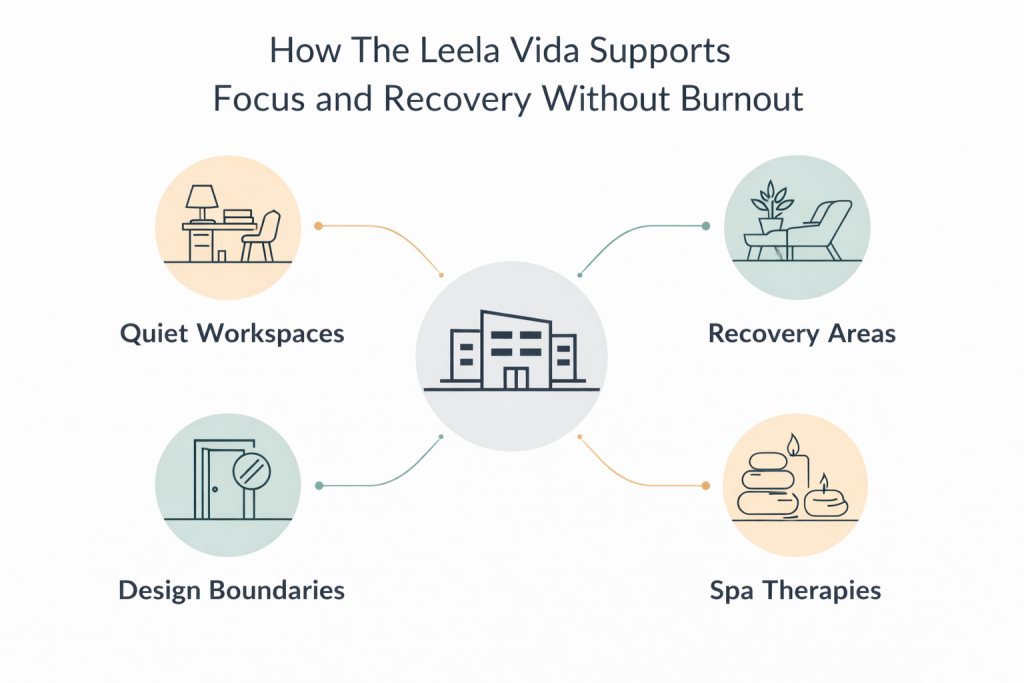
The Leela Vida supports focus and recovery without burnout through private workspaces, quiet recovery areas, and environments designed to reduce stimulation.
Can improving recovery really restore focus?
Yes. When recovery improves, focus returns before motivation or energy, leading to more consistent performance.