
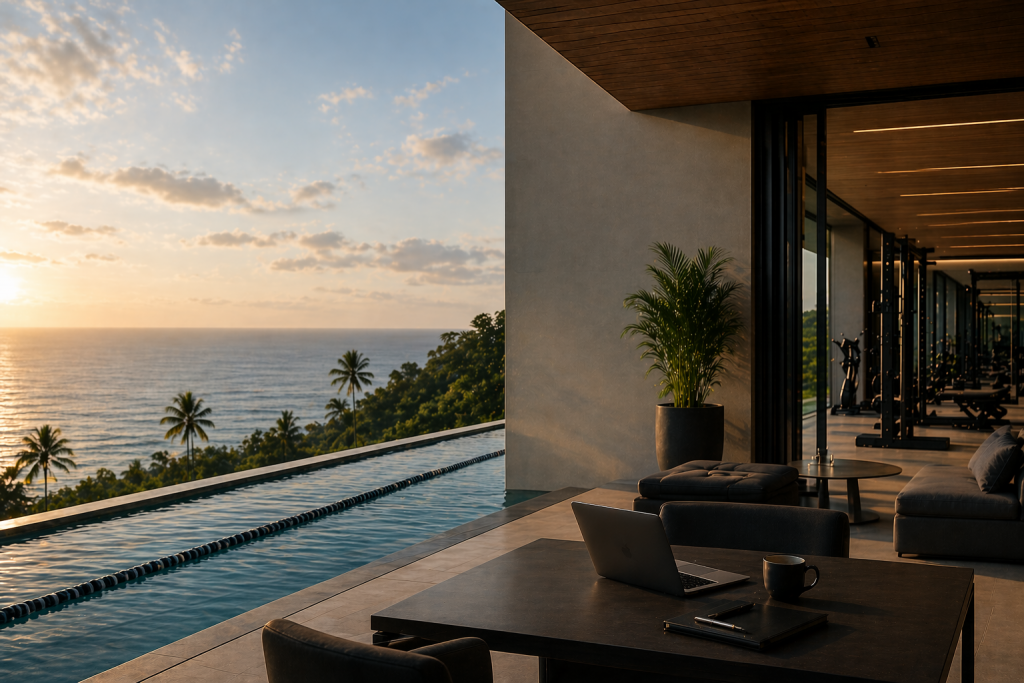
Illustration for conceptual purposes. Actual facilities and experiences at The Leela Vida may vary.
A serious professional rarely has a time-management problem. More often, the problem is environmental. The day is fragmented by transit, noise, crowded gyms, unreliable workspaces, and food that does not support output. A private members club for professionals addresses that issue directly by reducing friction across the full operating day.
This only matters to a certain type of person. If your schedule is built around meetings, decision-making, training, recovery, and sustained cognitive performance, your environment is not a lifestyle detail. It is part of the system. The right setting protects rhythm. The wrong one drains it.
What a private members club for professionals actually provides
Many spaces claim to support performance. Most are partial solutions. A gym improves one part of the day. A coworking space handles another. A café fills a gap in between. Recovery, if it exists at all, is usually separate and inconsistent. The result is not efficiency. It is constant transition.
A true private members club for professionals is built differently. It combines training, work, recovery, assessment, and nutrition inside one controlled environment. That changes the quality of the day in a practical way. Less movement between locations means less lost time, fewer interruptions, and more consistency.
Privacy matters just as much as convenience. High-performing professionals are not looking for public-facing spaces that run on traffic and volume. They need discretion, order, and the ability to move through a routine without unnecessary exposure. A membership cap, if it is properly enforced, is not a branding device. It is operational protection.
Why fragmented routines reduce output
Most professionals accept fragmentation because it is common. They train early in a crowded commercial gym, take calls from a car, work from a café between meetings, and fit recovery in when possible. None of this is catastrophic on its own. The issue is cumulative.
Repeated transitions consume attention. Noise changes your pace. Delays shift your training window. Public environments invite low-level interruption. Poor food choices create an energy drop later in the day. By the end of the week, the problem is not effort. It is inconsistency.
That is why controlled environments matter. They reduce the number of decisions required to stay on plan. When the gym, workspace, recovery suite, and food are all present and aligned, discipline is easier to maintain because the structure supports it.
This does not mean every professional needs the same setup. Some people thrive with a simpler arrangement. Others only notice the value of integration once their workload reaches a level where every transition has a cost. The threshold depends on how tightly your day is managed and how much your performance depends on clarity over long periods.
The difference between status and function
The phrase private members club can suggest social access, hospitality, or prestige. For professionals with a performance-based schedule, those are not the primary concerns.
Function comes first. The environment should help you move from training to work, from work to recovery, and from recovery back into output without losing momentum. Space should feel calm, not performative. Service should be precise, not intrusive. Design should support routine, not distraction.
This is where many clubs miss the mark. They offer privacy, but not utility. Or they offer amenities, but no structure. A room with good lighting and polished finishes is not the same as an environment designed for repeated daily use by people with demanding schedules.
A useful standard is simple: does the space improve the mechanics of the day, or does it only look appealing from the outside?
What professionals should look for
The quality of a private club is not determined by how many features it can list. It is determined by whether those features work together.
A performance-led training space
A serious training environment should be quiet, well maintained, and intentionally equipped. It should allow focused sessions without crowding, delays, or social spillover. For professionals who train as part of their operating routine, the setting needs to support consistency rather than novelty.
Recovery that is structured, not optional
Recovery is often treated as an extra. For people managing heavy workloads, it should be built into the system. Whether through cold exposure, heat, guided protocols, or other recovery tools, the purpose is the same: reduce accumulated fatigue and improve readiness for the next block of work.
Workspaces that preserve concentration
A shared table and strong Wi-Fi do not create a productive workspace. Professionals need privacy, acoustic control, and enough separation to handle calls, focused work, and decision-making without interference. The best workspaces support output without asking for attention.
Nutrition that fits the day
Food should not interrupt rhythm. It should be accessible, well prepared, and aligned with performance rather than convenience alone. This is less about rigid dieting and more about removing the usual compromise of having to choose between efficiency and quality.
Systems for measurement
Assessment matters because routine without feedback can drift. Body metrics, performance tracking, and structured review create a more accurate view of progress. For some members this is essential. For others it is useful only at certain phases. Either way, a serious environment should allow measurement, not rely on assumption.
Why membership caps matter
Capacity shapes behavior. Once a space becomes crowded, the atmosphere changes quickly. Noise rises. Equipment access becomes uncertain. Privacy weakens. Staff attention becomes reactive rather than precise.
For a professional audience, this has direct consequences. You cannot build a dependable routine around unpredictability. A strict membership cap protects the environment by keeping volume at a level where calm, discretion, and access remain intact.
This can make a club feel selective, but selectivity is not the point. Stability is. The real value is knowing the environment will function tomorrow in the same way it functions today.
Where Barbados becomes relevant
Location only matters if it changes how the environment is used. In Barbados, that is often the case. The island attracts founders, executives, remote operators, and long-stay residents whose work does not pause because they are near the water. They still need structure. They still need output.
That creates a specific demand: a place that supports a high standard of daily routine without the noise and looseness that often define island living from the outside. For the right member, an oceanfront setting is not about leisure. It is about having a calm physical environment while maintaining professional discipline.
This is where a space such as The Leela Vida becomes distinct. Not because it combines desirable categories, but because it treats training, work, recovery, and nutrition as one operating system rather than four separate errands.
Who this model is actually for
Not every ambitious person needs a private club. Some prefer complete independence. Others use separate spaces effectively enough that integration would add little.
But for professionals who value routine, privacy, and controlled conditions, the model makes practical sense. It suits people who train regularly, manage a serious workload, avoid crowded public environments, and want fewer breaks in concentration across the day.
It is especially useful for those spending extended time in one location and trying to maintain standards without rebuilding their routine from scratch. The less tolerance you have for friction, the more valuable a well-run private environment becomes.
The better question is not whether a private members club sounds appealing. It is whether your current setup protects your standards or quietly erodes them. For professionals, that difference tends to show up in the calendar first, then in performance.